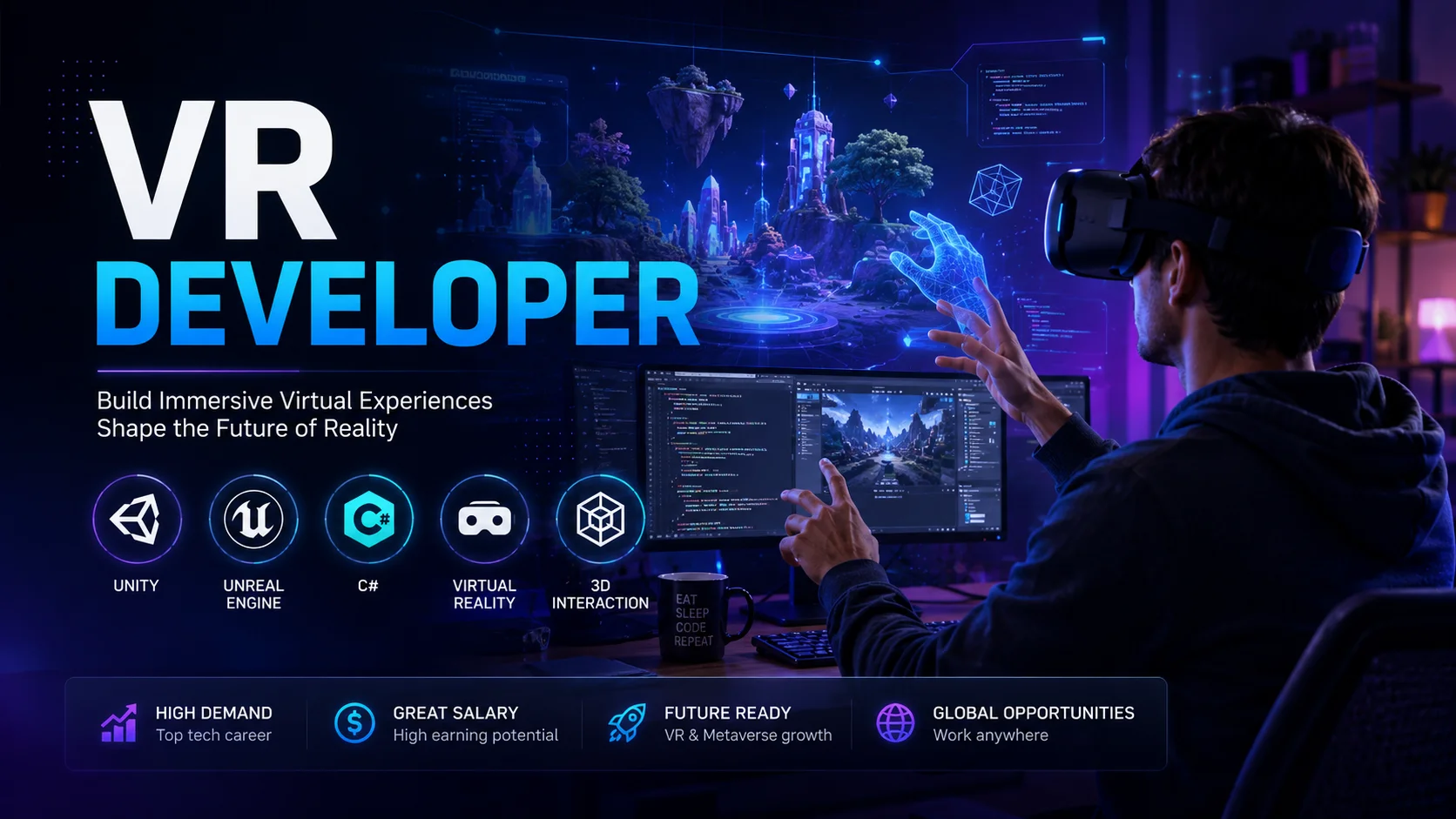
VR Developer
Build immersive virtual reality experiences, interactive simulations, metaverse environments, and next-generation 3D applications for gaming, healthcare, education, and enterprise industries.
Average Salary
₹9.8 LPA
Range: ₹4 LPA - ₹38 LPA
Demand Score
Very High
Rapidly growing demand across gaming, healthcare, training, architecture, and metaverse industries
Remote Opportunities
68%
Many VR studios and simulation companies now hire remote developers for global XR projects
Future Growth
+32%
VR and immersive computing are expected to expand significantly with AI, gaming, training, and spatial computing adoption
What Does a VR Developer Do?
A VR Developer designs and develops immersive digital environments that users can interact with using virtual reality devices such as Meta Quest, HTC Vive, PlayStation VR, Apple Vision Pro, and mixed reality headsets. These developers combine software engineering with 3D interaction systems to create highly engaging virtual experiences. VR Developers often work with engines like Unity and Unreal Engine to build applications that support real-time rendering, physics simulation, motion tracking, hand gestures, multiplayer interaction, and spatial audio systems. Their work is used in industries far beyond gaming. Today, VR technology is actively used in healthcare simulations, pilot training, military systems, architecture walkthroughs, manufacturing safety training, education platforms, virtual tourism, and immersive e-commerce experiences. A strong VR Developer understands 3D mathematics, optimization techniques, interactive storytelling, graphics rendering, and user interaction principles. Since VR applications require high performance and low latency, developers must focus heavily on optimization and smooth rendering pipelines. This field is becoming increasingly valuable as companies invest in metaverse technologies, mixed reality systems, digital twins, AI-powered simulations, and immersive training platforms. Developers who combine creativity with technical skills can build highly future-proof careers in this domain.
Immersive Experiences
Build interactive 3D virtual environments
Game Engine Expertise
Work with Unity and Unreal Engine
Spatial Computing
Develop next-generation immersive applications
Real-Time Rendering
Create optimized high-performance experiences
Metaverse Systems
Build social and enterprise virtual worlds
Cross-Industry Demand
Opportunities across gaming
Role Snapshot
₹4.5 LPA
Entry Level Salary
0 - 1 Year
₹10 LPA
Mid-Level Salary
2 - 5 Years
₹22 LPA+
Senior VR Engineer
5+ Years
Global Demand
Future Technology Career
Strong International Opportunities
Hybrid Work
Flexible Development Roles
Growing Remote Hiring
Roadmap to Become a VR Developer
Learn C# or C++ fundamentals deeply
Build interactive VR projects using Unity Engine
Learn advanced real-time rendering and Blueprints
Understand vectors
rotations
Learn Oculus SDK
OpenXR
Build immersive interactions and mechanics
Improve FPS
rendering
Learn immersive sound design integration
Understand networking for virtual collaboration systems
Create VR games
simulations
Core Skills
Salary Insights
View full report →Salary by Experience
Salary by City (Avg. LPA)
Bengaluru₹11.5 LPA +12%
Pune₹9.2 LPA +6%
Hyderabad₹10.4 LPA +8%
Mumbai₹9.8 LPA +5%
Gurugram₹10.7 LPA +9%
Remote International Roles₹18 LPA+ +25%
Interview Preparation
View all topics →Unity 3D
45+ Questions
Unreal Engine
40+ Questions
C# Fundamentals
35+ Questions
VR Optimization
30+ Questions
3D Mathematics
25+ Questions
Game Physics
20+ Questions
XR SDKs
20+ Questions
System Design for VR
15+ Questions
Portfolio Review
Real Project Demonstration
Behavioral Round
Collaboration and problem-solving discussion
Who Should Become a VR Developer?
- • Students interested in gaming and immersive technologies
- • Developers who enjoy 3D interaction systems
- • People passionate about futuristic technologies
- • Creative individuals who enjoy interactive storytelling
- • Programmers interested in graphics and rendering systems
- • Developers who want to work on metaverse platforms
- • People interested in simulation and training systems
- • Students who enjoy combining creativity with coding
- • Individuals looking for future-focused tech careers
- • Developers who like real-time visual technologies
Role Highlights
- • High future growth potential
- • Strong global demand
- • Creative and technical career combination
- • Excellent international opportunities
- • Growing metaverse industry adoption
- • High-paying specialized technology role
- • Strong portfolio-based hiring opportunities
- • Expanding use in healthcare and enterprise sectors
- • Opportunity to build futuristic products
- • Remote work opportunities increasing rapidly