Home > Roles > DevOps Engineer
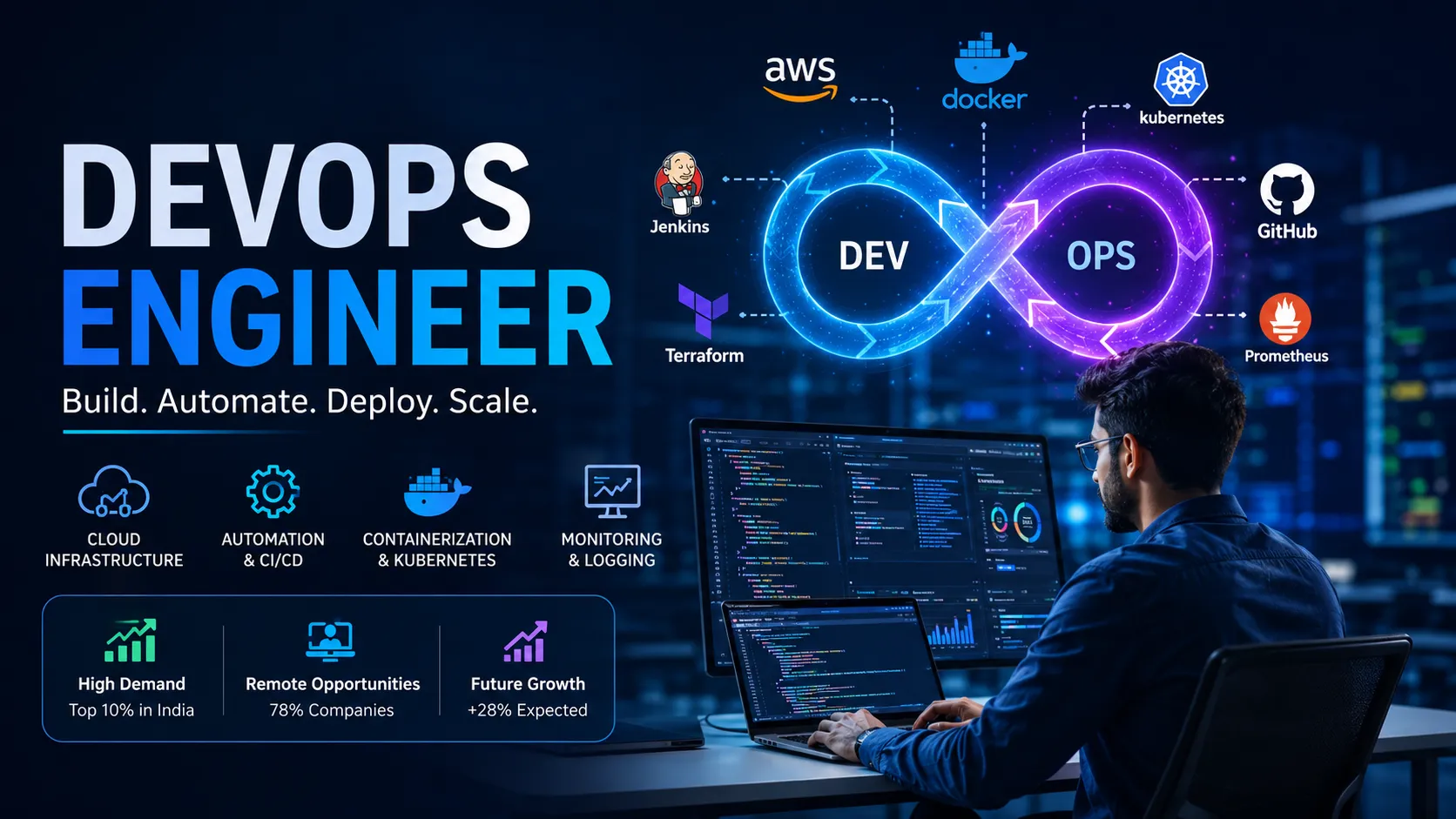
DevOps Engineer
Build, automate, deploy, and manage modern cloud infrastructure with speed and reliability.
Average Salary
₹7.5 LPA
Range: ₹3.5 - ₹24 LPA
Demand Score
Very High
One of the fastest growing cloud and infrastructure careers worldwide
Remote Opportunities
78%
Many global companies hire remote DevOps Engineers for cloud operations
Future Growth
+28%
Cloud adoption and automation are increasing rapidly across industries
What Does a DevOps Engineer Do?
A DevOps Engineer is responsible for building and maintaining reliable software delivery systems. They automate deployments, manage cloud infrastructure, improve server security, monitor application health, and optimize development workflows. Companies depend on DevOps Engineers to reduce downtime, speed up deployments, and scale applications efficiently. This role combines development, cloud computing, networking, Linux administration, security, automation, and monitoring skills. DevOps Engineers often work with tools like Docker, Kubernetes, AWS, Jenkins, Terraform, GitHub Actions, Prometheus, and Linux servers. Freshers entering DevOps can grow quickly because cloud infrastructure skills are in massive demand. Many companies now prefer developers who also understand deployment and automation systems.
Cloud Infrastructure
Manage scalable servers and cloud environments
Automation Pipelines
Build CI/CD workflows for faster deployments
System Monitoring
Track application health and server performance
Containerization
Work with Docker and Kubernetes clusters
Security Practices
Improve infrastructure security and reliability
High Demand Career
Strong hiring growth in cloud and SaaS companies
Role Snapshot
₹3.5 LPA
Entry Level Salary
0 - 1 Year
₹8.5 LPA
Mid-Level Salary
2 - 5 Years
₹18+ LPA
Senior Level Salary
5+ Years
Remote Friendly
Work Flexibility
Global hiring opportunities
Fast Growth
Career Expansion
Cloud and automation demand rising
DevOps Engineer Roadmap
Learn Linux commands and server management
Understand IP
DNS
Learn version control and collaboration workflows
Start with AWS or Azure cloud services
Learn containerization and image management
Build deployment automation using Jenkins or GitHub Actions
Understand container orchestration and scaling
Learn Terraform and automation scripting
Use Prometheus and Grafana for monitoring
Learn server hardening and cloud security practices
Core Skills
Salary Insights
View full report →Salary by Experience
Salary by City (Avg. LPA)
Bengaluru₹9.2 LPA +10%
Hyderabad₹8.5 LPA +8%
Pune₹7.8 LPA +5%
Mumbai₹8.1 LPA +6%
Chennai₹7.4 LPA +4%
Delhi NCR₹8.7 LPA +7%
Interview Preparation
View all topics →Linux Commands
40+ Questions
Docker & Kubernetes
50+ Questions
AWS Fundamentals
35+ Questions
CI/CD Pipelines
30+ Questions
Networking Basics
25+ Questions
Terraform & IaC
20+ Questions
Monitoring Tools
20+ Questions
DevOps Scenarios
Real-world troubleshooting practice
Who Should Become a DevOps Engineer?
- • Students interested in cloud computing
- • Developers who enjoy automation
- • People interested in servers and infrastructure
- • Candidates who like problem solving
- • Freshers looking for high growth tech careers
- • Developers wanting remote job opportunities
- • People interested in Linux and cloud platforms
- • Candidates aiming for global tech companies
Role Highlights
- • High salary growth potential
- • Massive global demand
- • Strong remote work opportunities
- • Works across multiple technologies
- • Excellent career stability
- • Cloud computing focused role
- • Automation driven workflow
- • Opportunity to work with large scale systems
- • Fast promotion opportunities
- • Strong freelancing and consulting demand