Why HR Rejects 90% Fresher Resumes
5/20/2026, 4:33:45 AM
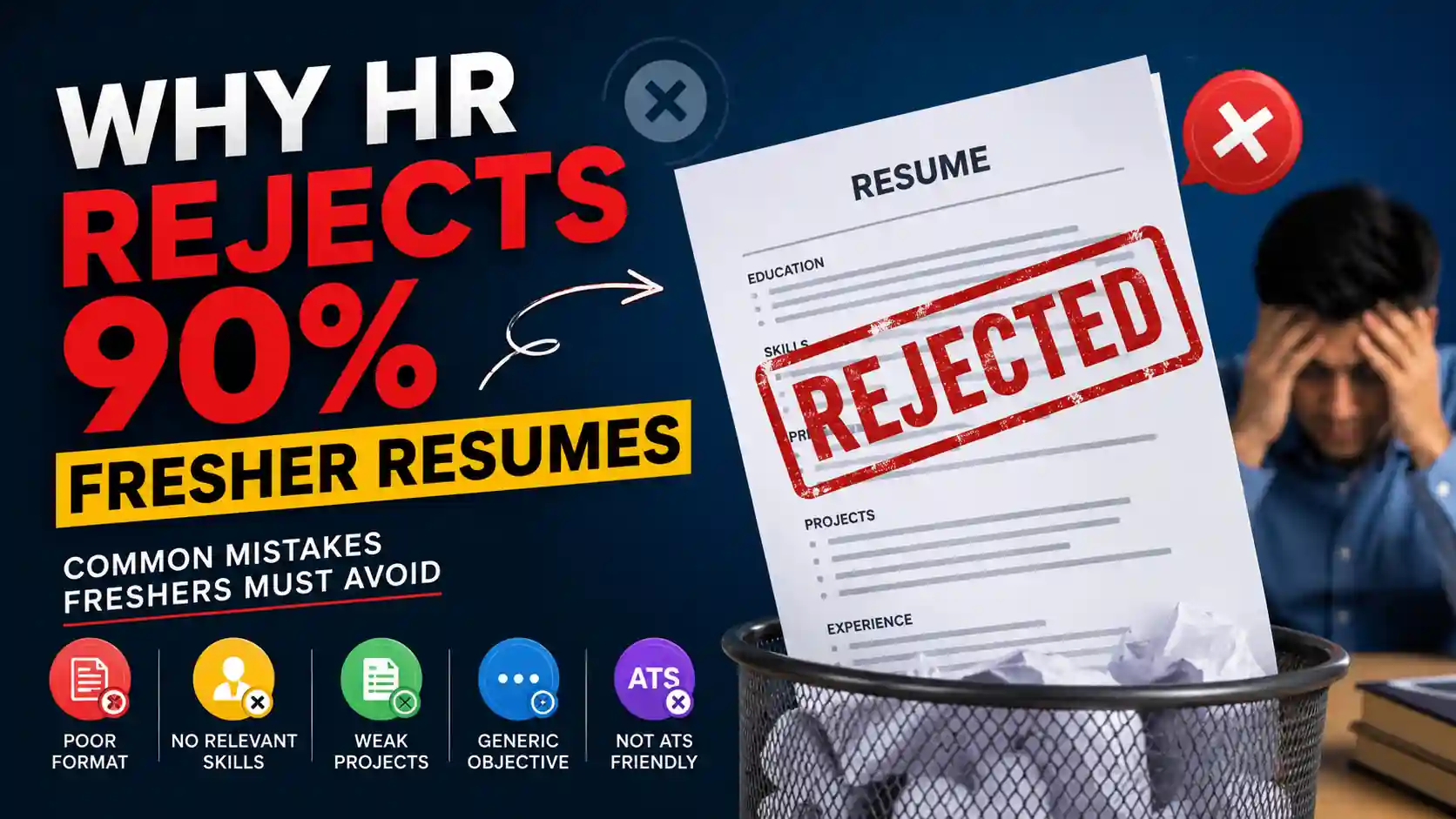
Many students believe that getting a degree is enough to start receiving interview calls. But the reality is very different. Every year, thousands of freshers apply for jobs with almost identical resumes, similar skills, and the same copied projects. Because of this, HR teams receive huge numbers of applications but only shortlist a few candidates.
This is one of the biggest reasons why many talented freshers never get interview opportunities even after applying to hundreds of jobs.
The problem is not always a lack of talent. In many cases, the resume itself creates a negative first impression before the recruiter even looks at the candidate properly.
Today, companies want candidates who can clearly show skills, communication, learning ability, and seriousness toward their career. A weak resume immediately signals the opposite.
In this guide, we will understand the real reasons why HR rejects most fresher resumes and what students can do to improve their chances of getting shortlisted.
Most Fresher Resumes Look Exactly the Same
One of the biggest problems HR teams face is repetition.
A recruiter may open 50 resumes in a single hour and notice the same:
- Same template
- Same career objective
- Same copied skills
- Same college projects
- Same buzzwords
Many students simply download a resume template from the internet and fill basic details without thinking about how to stand out.
When every resume looks identical, recruiters start skipping applications quickly.
For example, these lines appear in thousands of resumes:
- “Hardworking and passionate individual”
- “Quick learner”
- “Team player”
- “Looking for an opportunity to grow”
These lines do not provide any real value because they are too generic.
Instead of writing broad claims, candidates should focus on showing actual work, practical projects, certifications, internships, freelancing, or problem solving abilities.
A resume becomes stronger when it contains proof instead of empty statements.
Poor Resume Formatting Creates a Bad First Impression
Many freshers underestimate formatting.
Some resumes contain:
- Too many colors
- Fancy fonts
- Large paragraphs
- Poor spacing
- Misaligned sections
- Unnecessary graphics
Recruiters usually spend only a few seconds scanning a resume initially. If the document looks messy, they may reject it without reading the details.
A clean and simple resume performs much better than an overdesigned one.
Good formatting should include:
- Clear headings
- Readable font
- Proper spacing
- Short bullet points
- Consistent structure
- One page for most freshers
Simple resumes are easier to scan and look more professional.
Lack of Practical Skills
Another major reason resumes get rejected is the absence of practical skills.
Many students only mention theoretical subjects from college but fail to demonstrate real work experience.
Companies today prefer candidates who have at least tried building something on their own.
For example:
- A web developer can build personal projects
- A cybersecurity student can create security labs
- A digital marketer can run small campaigns
- A data analyst can work on datasets and dashboards
Practical work helps recruiters trust the candidate more.
Even small self-made projects can create a stronger impression than long lists of theoretical subjects.
Resume Contains Too Many Fake Skills
This is one of the most common mistakes among freshers.
Some students add every trending technology to their resume without proper knowledge.
For example:
- AI
- Machine Learning
- Cloud Computing
- Kubernetes
- DevOps
- Blockchain
- Data Science
But during interviews, they cannot answer basic questions related to those skills.
Recruiters and interviewers notice this quickly.
It is always better to mention fewer skills with stronger understanding instead of adding random technologies just to make the resume look impressive.
Honesty matters a lot during hiring.
Weak Projects Hurt the Resume
Projects play a huge role in fresher hiring.
Unfortunately, many students use copied projects from YouTube tutorials or GitHub repositories without understanding how they work.
HR and technical interviewers often see the same projects repeatedly:
- Basic calculator
- To-do app
- Weather app
- Library management system
These projects are not necessarily bad, but if there is no originality or improvement, they fail to create impact.
A better approach is:
- Add unique features
- Solve real problems
- Explain your contribution clearly
- Mention technologies properly
- Include project outcomes
Even a small but original project can outperform copied complex projects.
Spelling and Grammar Mistakes
Small mistakes create a negative impression.
If a resume contains:
- Grammar issues
- Spelling errors
- Incorrect punctuation
- Broken sentences
Recruiters may think the candidate lacks attention to detail.
This becomes even more important for:
- Content roles
- Marketing jobs
- HR positions
- Client-facing jobs
Before sending a resume, students should always:
- Recheck spelling
- Read the resume slowly
- Use grammar checking tools
- Ask someone else to review it
Professional communication matters in every industry.
Career Objective Sections Are Often Meaningless
Many resumes still contain outdated career objectives.
Example:
“Seeking a challenging organization where I can enhance my skills and contribute to company growth.”
Recruiters have read this line thousands of times.
Instead of writing generic objectives, candidates should use that space more effectively.
Better alternatives include:
- Skills summary
- Internship highlights
- Technical expertise
- Certifications
- Portfolio links
Recruiters care more about value than motivational lines.
ATS Systems Reject Many Resumes Automatically
Many companies now use Applicant Tracking Systems, also known as ATS.
These systems scan resumes before a human recruiter even sees them.
If the resume:
- Lacks keywords
- Uses poor formatting
- Contains images or tables
- Has unreadable structure
the system may reject it automatically.
This is why ATS-friendly resumes are becoming important.
To improve ATS compatibility:
- Use simple formatting
- Avoid unnecessary graphics
- Use proper section headings
- Include job-relevant keywords naturally
- Save resumes in accepted formats
A clean structure improves both ATS readability and recruiter experience.
No Customization for Different Jobs
Many freshers send the exact same resume to every company.
This reduces shortlist chances significantly.
Different companies look for different skills.
For example:
- Startup companies may value practical skills
- MNCs may prefer structured resumes
- Product companies may focus heavily on projects
- Marketing companies may prioritize communication
Customizing resumes according to the role improves relevance.
Even small modifications can make a big difference.
Lack of Portfolio or Online Presence
Today, recruiters often search candidates online before scheduling interviews.
If a fresher has:
- LinkedIn profile
- GitHub account
- Portfolio website
- Personal projects
- Certifications
their credibility increases.
A strong online presence helps recruiters trust the candidate more.
This is especially important in:
- Software development
- Design
- Marketing
- Content creation
- Data analytics
Students who build visible proof of skills usually stand out faster.
Many Freshers Ignore Communication Skills
Technical skills alone are not enough anymore.
Companies also want candidates who can:
- Communicate clearly
- Explain ideas properly
- Work with teams
- Learn quickly
- Handle responsibilities
Sometimes a candidate with moderate technical knowledge but strong communication gets selected over someone with higher technical skills but poor interaction ability.
This is why resume language should also sound clear and professional.
Quantity of Applications Does Not Guarantee Success
Many freshers apply to hundreds of jobs daily without improving their resume.
This creates frustration because rejection continues repeatedly.
Instead of only increasing applications, students should:
- Improve resume quality
- Build stronger projects
- Learn practical skills
- Customize applications
- Improve LinkedIn presence
- Practice interviews
Smart improvement matters more than mass applying.
Final Thoughts
Most fresher resumes get rejected not because students are untalented, but because their resumes fail to show value properly.
A strong resume does not need:
- Fancy designs
- Fake skills
- Long paragraphs
- Overhyped claims
Instead, it needs:
- Clarity
- Practical work
- Honest skills
- Good formatting
- Relevant projects
- Professional communication
Students who focus on building real skills and presenting them properly already move ahead of a large percentage of applicants.
The job market is competitive, but companies are still hiring freshers who show effort, learning ability, and practical thinking.
A resume is not just a document. It is the first impression of your professional mindset.