The Rise of AI-Native Jobs: Careers That Didn't Exist 3 Years Ago
6/24/2026, 12:49:33 PM
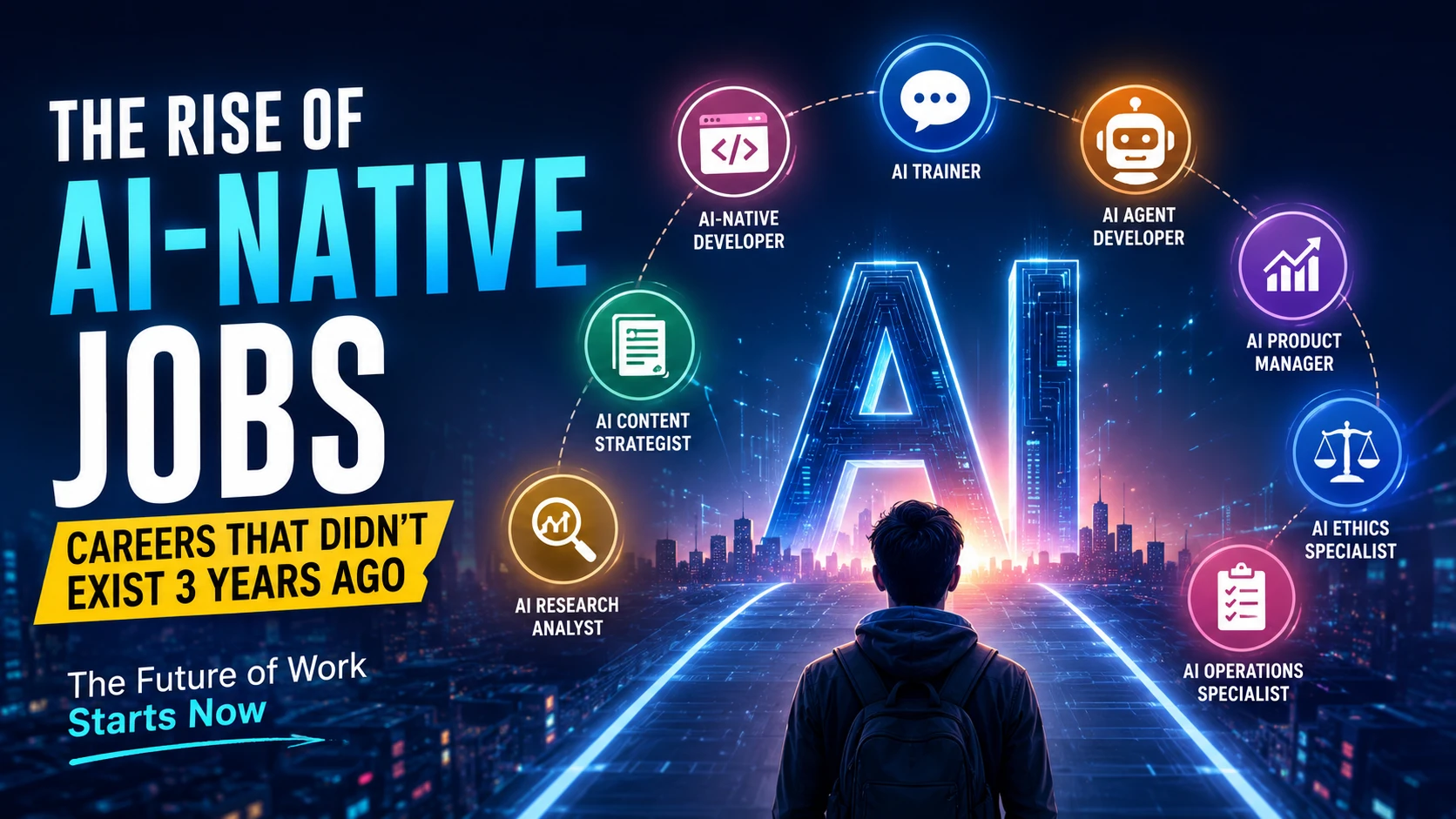
Artificial intelligence is no longer a technology of the future. It has become a part of our daily lives, workplaces, businesses, and industries. Over the last three years, AI has evolved at a speed that very few people expected. Tools like ChatGPT, Claude, Gemini, Midjourney, Cursor, GitHub Copilot, and countless AI-powered platforms have transformed how companies operate and how people work.
Whenever a major technological shift happens, some jobs disappear, some jobs change, and entirely new careers emerge. This is exactly what we are witnessing today.
Three years ago, very few companies were hiring Prompt Engineers, AI Trainers, AI Product Managers, or AI Operations Specialists. Most of these roles either did not exist or were limited to research laboratories and specialized technology firms. Today, startups, multinational corporations, healthcare organizations, financial institutions, media companies, and even government agencies are actively searching for professionals who can work alongside AI systems.
This shift has created a new category of employment known as AI-native jobs.
These are roles that are built around artificial intelligence rather than simply using AI as a supporting tool. In many cases, these jobs would not exist without modern AI technology.
For students, freshers, and working professionals, understanding these emerging careers may be one of the most important career decisions they make in the coming years.
In this guide, we will explore what AI-native jobs are, why they are growing so rapidly, and which careers are creating exciting opportunities in 2026 and beyond.
What Are AI-Native Jobs?
AI-native jobs are careers specifically designed around artificial intelligence systems, workflows, products, and applications.
Unlike traditional roles where AI is simply used as a tool, AI-native professionals work directly with AI models, automation systems, machine learning platforms, and intelligent software solutions.
For example:
A graphic designer may use AI tools occasionally.
An AI Content Strategist builds entire content systems powered by AI.
A software developer may use AI coding assistants.
An AI-Native Software Engineer designs applications where AI becomes the core feature of the product.
The difference is significant.
AI-native jobs place artificial intelligence at the center of the work rather than treating it as an additional productivity tool.
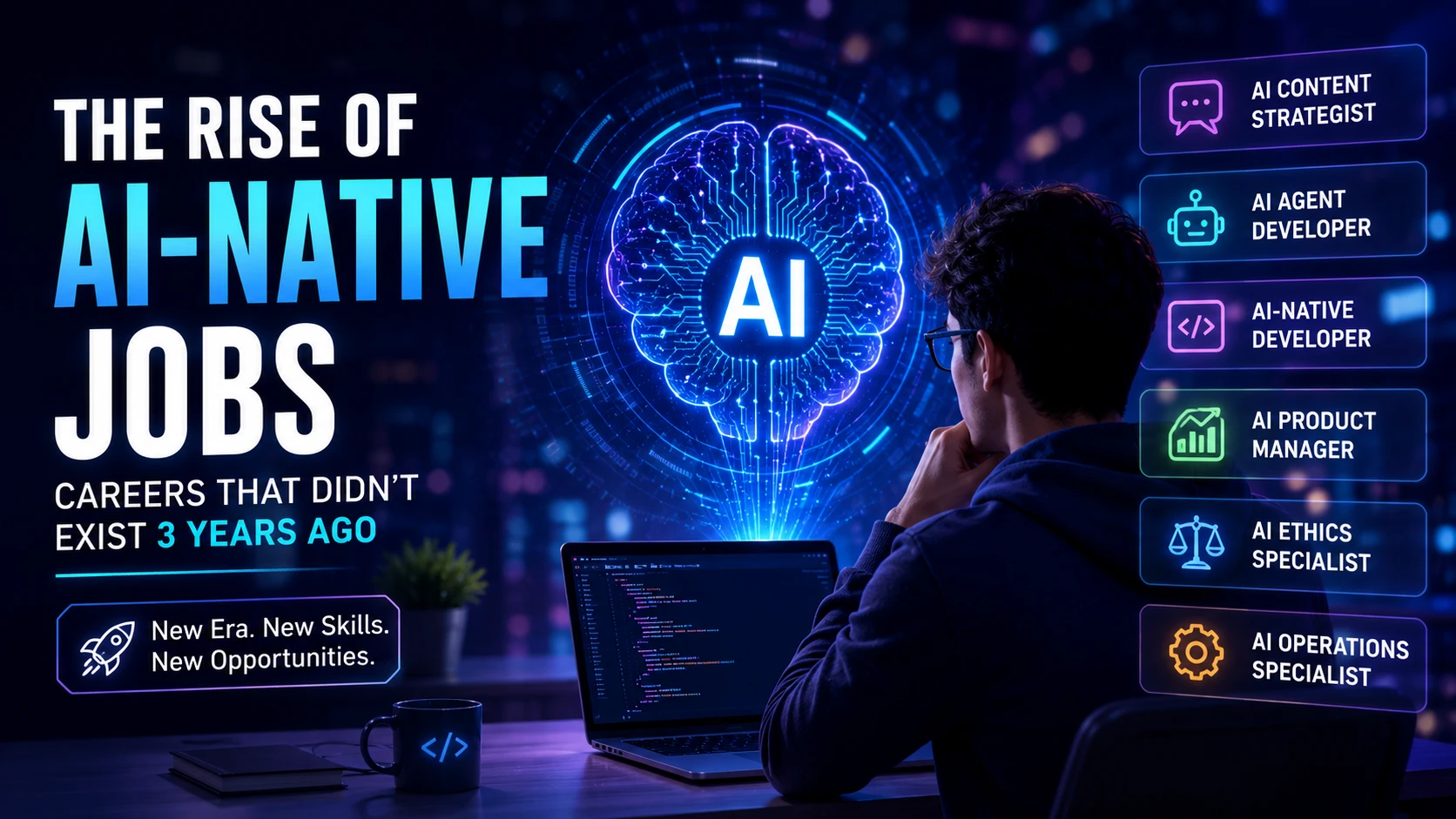
Why AI-Native Careers Are Growing So Fast
Several factors are driving the growth of AI-native careers.
Businesses Want More Productivity
Companies are under constant pressure to improve efficiency.
AI helps businesses automate repetitive tasks, reduce costs, improve customer service, and accelerate innovation.
As organizations adopt AI systems, they need professionals who understand how to build, manage, monitor, and optimize these technologies.
AI Tools Have Become More Accessible
Three years ago, developing AI solutions required advanced technical expertise and significant resources.
Today, cloud platforms, APIs, and AI models have made implementation much easier.
Even small startups can integrate advanced AI capabilities into their products.
This accessibility has created demand for new job roles.
The Explosion of Generative AI
Generative AI transformed the industry almost overnight.
Businesses suddenly realized they could generate content, code, images, videos, reports, and customer responses using AI.
However, successful implementation requires human oversight, strategy, and optimization.
This created entirely new career paths.
Companies Need AI Governance
As AI adoption increases, concerns about ethics, security, privacy, compliance, and bias are also growing.
Organizations now need professionals who can ensure responsible AI deployment.
This requirement has generated another wave of specialized careers.
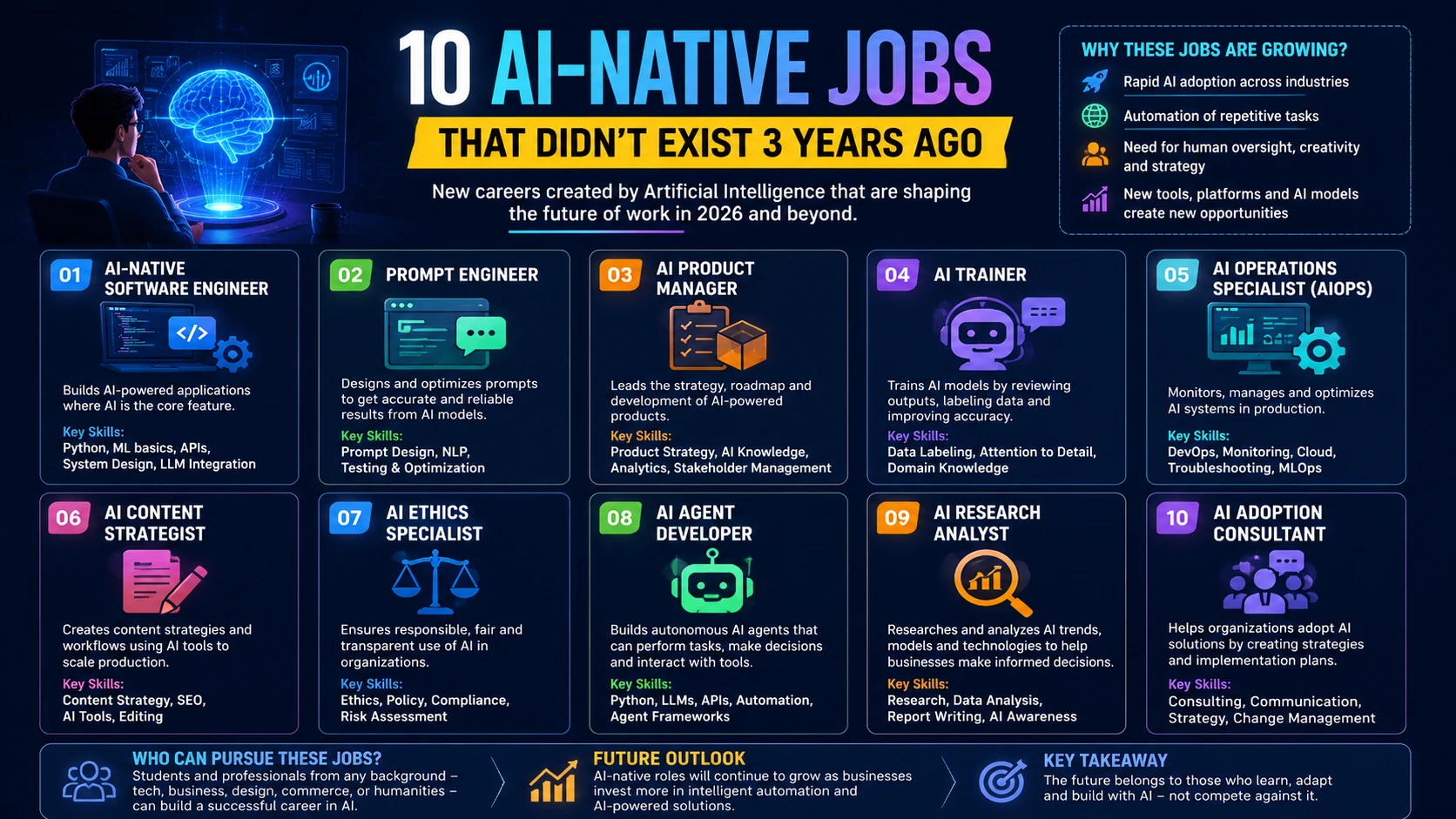
Top AI-Native Jobs in 2026
Let's explore some of the most exciting careers that have emerged recently.
1. AI-Native Software Engineer
This is one of the fastest-growing technology careers today.
AI-Native Software Engineers build applications where AI acts as a fundamental component rather than an optional feature.
Responsibilities include:
- Building AI-powered products
- Integrating large language models
- Creating AI workflows
- Developing intelligent automation systems
- Managing AI agents
Companies like startups, SaaS businesses, gaming firms, and enterprise software providers are actively hiring for this role.
Average Salary:
- Freshers: $25,000 to $60,000 globally
- Experienced professionals: $100,000+ annually
2. Prompt Engineer
A few years ago, almost nobody had heard of prompt engineering.
Today, organizations need professionals who can communicate effectively with AI models and generate reliable outputs.
Prompt Engineers:
- Design prompts
- Test AI behavior
- Improve response quality
- Create reusable prompt libraries
- Optimize AI workflows
Although the role continues to evolve, prompt engineering remains a valuable skill across multiple industries.
3. AI Product Manager
Traditional Product Managers focus on software products.
AI Product Managers focus specifically on AI-powered solutions.
Their responsibilities include:
- Defining AI product strategy
- Understanding user requirements
- Working with AI engineers
- Measuring AI performance
- Ensuring business goals are achieved
This role combines technical understanding with business leadership.
4. AI Trainer
AI systems learn from data, feedback, and human guidance.
AI Trainers help improve AI performance by teaching systems how to respond more accurately.
Tasks include:
- Reviewing outputs
- Labeling data
- Evaluating responses
- Identifying errors
- Improving training datasets
Many companies hire remote AI Trainers globally.
5. AI Operations Specialist (AIOps)
As organizations deploy AI systems at scale, operational management becomes critical.
AI Operations Specialists monitor and maintain AI infrastructure.
Responsibilities include:
- Monitoring model performance
- Managing AI deployments
- Troubleshooting issues
- Tracking system reliability
- Improving operational efficiency
This role is becoming increasingly important in large enterprises.
6. AI Content Strategist
Content creation has changed dramatically.
AI Content Strategists combine creativity with technology.
They manage:
- AI-assisted content production
- Content workflows
- SEO optimization
- Editorial planning
- AI-generated content quality control
Businesses increasingly rely on these professionals to scale content operations.
7. AI Ethics Specialist
As AI becomes more powerful, ethical concerns are growing.
AI Ethics Specialists help organizations ensure responsible AI practices.
Their responsibilities include:
- Identifying bias
- Ensuring fairness
- Reviewing compliance
- Creating governance policies
- Assessing AI risks
This role is expected to grow significantly over the next decade.
8. AI Agent Developer
AI agents are becoming one of the hottest trends in technology.
These autonomous systems can perform tasks, make decisions, interact with tools, and complete workflows.
AI Agent Developers build:
- Customer support agents
- Research agents
- Automation agents
- Business workflow agents
- Multi-agent systems
This field is expected to create thousands of new jobs globally.
9. AI Research Analyst
Organizations need experts who can understand rapidly changing AI developments.
AI Research Analysts:
- Track industry trends
- Evaluate new models
- Compare technologies
- Prepare reports
- Recommend solutions
This role combines research skills with technical knowledge.
10. AI Adoption Consultant
Many businesses want to implement AI but do not know where to start.
AI Adoption Consultants help organizations identify opportunities and create implementation strategies.
Their work includes:
- Assessing business needs
- Selecting tools
- Training teams
- Creating AI roadmaps
- Measuring ROI
This career is growing rapidly among consulting firms.
Skills Required for AI-Native Careers
The good news is that most AI-native jobs do not require a PhD in artificial intelligence.
Instead, employers often look for a combination of technical and practical skills.
Important skills include:
- AI fundamentals
- Prompt engineering
- Data analysis
- Python programming
- Machine learning basics
- Communication skills
- Problem-solving
- Critical thinking
- Workflow automation
- Product understanding
The ability to learn quickly is often more valuable than mastering a single tool.
Which Students Should Consider AI-Native Careers?
AI-native careers are not limited to computer science graduates.
Students from various backgrounds can enter this field.
Examples include:
BCA Students
Can become AI Developers, Prompt Engineers, or AI Operations Specialists.
BBA Students
Can pursue AI Product Management or AI Consulting.
Journalism Students
Can transition into AI Content Strategy.
Design Students
Can explore AI-powered design and creative workflows.
Commerce Students
Can work in AI-driven analytics and business intelligence.
The opportunities extend far beyond traditional technology roles.
Will AI Replace These Jobs Too?
This is one of the most common questions.
The reality is that AI will continue evolving.
Some AI-native roles may change over time.
However, the professionals who understand how AI works, how businesses use it, and how to improve AI systems will remain valuable.
History shows that technology creates more opportunities than it destroys.
The internet created careers that did not exist in the 1990s.
Mobile technology created careers that did not exist in the early 2000s.
Artificial intelligence is following the same pattern.
The challenge is not whether AI will replace jobs.
The challenge is whether workers can adapt quickly enough.
How Freshers Can Prepare for AI-Native Jobs
Students and recent graduates can start today.
Follow these steps:
Learn AI Fundamentals
Understand machine learning, large language models, and generative AI.
Experiment With AI Tools
Use ChatGPT, Gemini, Claude, Midjourney, Perplexity, and other platforms regularly.
Build Projects
Create AI-powered applications, websites, automations, or content systems.
Develop Technical Skills
Learn Python, APIs, automation tools, and data analysis.
Create an Online Presence
Share projects on LinkedIn, GitHub, and personal portfolios.
Stay Updated
The AI industry changes rapidly. Continuous learning is essential.
The Future of AI-Native Work
The next five years could produce more AI-related careers than any previous technological revolution.
Experts predict that businesses will increasingly hire professionals who can collaborate effectively with AI systems.
Future roles may include:
- AI Workflow Architect
- AI Security Specialist
- Synthetic Data Engineer
- Human-AI Collaboration Manager
- Autonomous Systems Designer
- AI Business Strategist
Many of these careers are only beginning to emerge.
Students entering the workforce today have a unique opportunity to position themselves at the forefront of this transformation.
Final Thoughts
The rise of AI-native jobs represents one of the biggest shifts in the modern workforce. Just three years ago, many of these careers did not exist. Today, they are among the fastest-growing opportunities across technology, business, content, consulting, and operations.
While some traditional jobs are being automated, entirely new professions are being created at an unprecedented pace. The individuals who understand how to work with AI, improve AI systems, and build AI-powered solutions will be in high demand for years to come.
For students, freshers, and professionals looking to future-proof their careers, now is the ideal time to start exploring AI-native opportunities. The companies shaping tomorrow's economy are already hiring for these roles today.
The future of work is not simply about artificial intelligence replacing humans. It is about humans and AI working together to create careers that were unimaginable just a few years ago.