The Real Difference Between Startup Jobs vs Corporate Jobs
5/21/2026, 5:08:27 AM
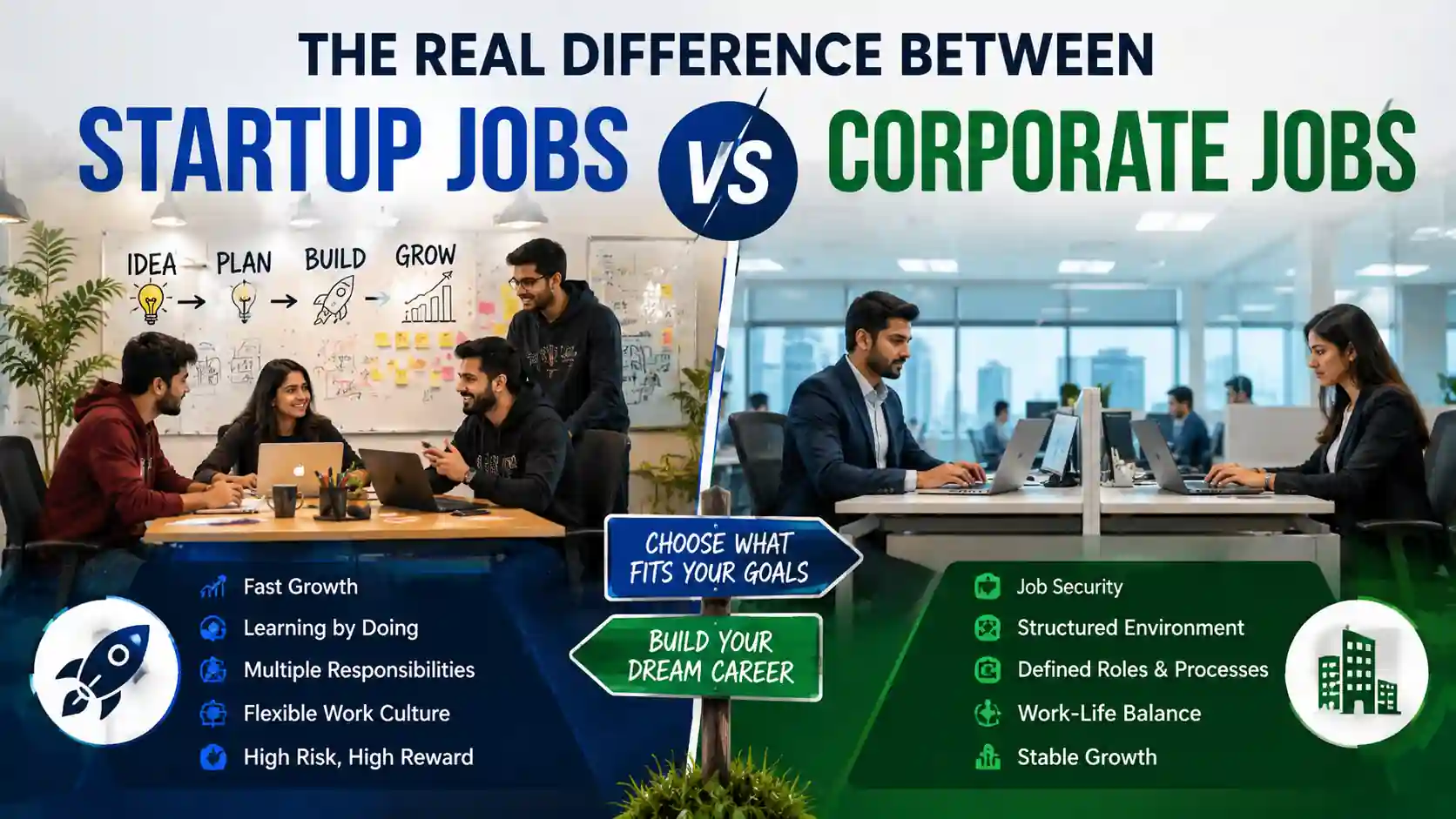
One of the biggest career questions freshers face today is this:
Should I join a startup or a corporate company?
Many students become confused while choosing between the fast-moving startup world and the structured environment of large companies. Some people believe startups are risky. Others think corporate jobs are too slow and boring.
The truth is that both career paths have advantages and disadvantages. The best choice depends on your personality, learning style, goals, and risk tolerance.
In recent years, startups in India have grown rapidly. At the same time, corporate companies and multinational organizations continue hiring thousands of freshers every year.
Because of this, students often compare:
- Salary
- Growth opportunities
- Work pressure
- Learning environment
- Job security
- Work-life balance
In this blog, we will understand the real difference between startup jobs and corporate jobs in a practical and honest way.
What Is a Startup Job?
A startup is usually a young company that is still growing and trying to expand quickly.
Most startups:
- Have smaller teams
- Move very fast
- Focus heavily on growth
- Expect employees to handle multiple responsibilities
In startups, employees often work closely with founders, managers, and product teams. The environment is usually flexible, fast-paced, and highly dynamic.
Examples of startup industries:
- AI companies
- SaaS businesses
- Fintech startups
- EdTech platforms
- HealthTech companies
- Creator economy platforms
Startups are often attractive for people who want faster learning and bigger responsibilities early in their careers.
What Is a Corporate Job?
Corporate jobs usually refer to positions in large organizations or multinational companies.
These companies:
- Have structured systems
- Follow established processes
- Use formal workflows
- Operate with multiple departments
Corporate companies generally have:
- HR teams
- Defined employee roles
- Training programs
- Reporting hierarchies
- Performance review systems
Examples include large technology companies, consulting firms, banks, and global service-based companies.
Corporate jobs are often preferred by people looking for stability and organized career growth.
Learning Opportunities
This is one of the biggest differences between startups and corporate companies.
Learning in Startups
In startups, employees usually learn very quickly because they handle multiple tasks.
For example:
- A developer may also interact with product teams
- A marketer may handle SEO, ads, and social media together
- A designer may work on UI, branding, and marketing visuals
Because teams are smaller, employees often gain exposure to many areas of the business.
This helps freshers build practical knowledge faster.
Many people say that one year in a startup can sometimes teach more practical skills than several years in a slow-moving environment.
Learning in Corporate Companies
Corporate companies usually provide structured learning.
Employees often:
- Receive formal training
- Work with senior professionals
- Follow specific processes
- Focus on one specialized role
This can build strong professional discipline and industry standards.
However, learning speed may sometimes feel slower because work is divided among many teams.
Work Pressure and Responsibilities
Startup Work Culture
Startup jobs can become stressful because companies move aggressively toward growth.
Employees may face:
- Tight deadlines
- Frequent changes
- Long working hours
- High expectations
Since teams are small, responsibilities are larger.
Some people enjoy this fast environment because it feels exciting and challenging. Others may feel overwhelmed.
Startups often reward people who:
- Adapt quickly
- Take initiative
- Solve problems independently
Corporate Work Culture
Corporate companies usually have more defined workflows.
Responsibilities are clearer, and employees often work within specific boundaries.
Compared to startups:
- Processes are more stable
- Workflows are documented
- Teams are larger
- Pressure may feel more manageable
However, corporate environments can sometimes feel slow because approvals and decisions move through multiple layers.
Salary and Compensation
Salary differences depend heavily on the company, industry, and role.
Startup Salary
Some startups offer:
- Competitive salaries
- Bonuses
- ESOPs or stock options
Fast-growing startups sometimes pay very well to attract skilled employees.
However, smaller startups may offer lower starting salaries initially.
The tradeoff is often faster growth and stronger learning opportunities.
Corporate Salary
Large companies usually provide:
- Stable monthly salaries
- Employee benefits
- Insurance
- Bonuses
- Structured increments
Salary growth may feel slower initially, but compensation tends to be more predictable.
Corporate companies also often provide better long-term stability.
Job Security
This is one of the most discussed topics.
Startup Job Security
Startups can be risky.
Some startups:
- Grow rapidly
- Become profitable
- Raise funding successfully
But others struggle financially.
Because of this, layoffs or sudden company changes may happen faster in startups.
Employees in startups must stay adaptable and continuously improve skills.
Corporate Job Security
Corporate organizations are usually more stable because they already have:
- Large clients
- Established revenue
- Bigger infrastructure
Although layoffs can still happen, overall stability is often higher compared to early-stage startups.
Many freshers prefer corporate companies because they feel safer financially.
Career Growth Speed
Growth in Startups
Growth can happen very fast in startups.
If an employee performs well:
- Promotions may come quickly
- Responsibilities increase faster
- Leadership opportunities appear earlier
Some employees move from junior roles to leadership positions within a few years.
This is one reason ambitious freshers often prefer startups.
Growth in Corporate Companies
Corporate growth is usually more structured.
Promotions may depend on:
- Experience
- Performance reviews
- Internal policies
- Business cycles
The process is often slower but more stable.
Corporate companies also provide clearer career ladders.
Work-Life Balance
Startup Environment
Work-life balance depends heavily on the startup culture.
Some startups maintain healthy environments, but many expect employees to stay highly involved.
Employees may work:
- Late nights
- Weekends during launches
- Under tight deadlines
This can create burnout if not managed properly.
Corporate Environment
Large companies often provide:
- Fixed schedules
- Paid leave
- Holiday structures
- Better process management
Because of this, work-life balance is sometimes better in corporate jobs.
However, this also depends on the team and management.
Innovation and Creativity
Startups usually encourage experimentation.
Employees may:
- Share ideas directly
- Influence products quickly
- Work on innovative features
This makes startups exciting for creative people.
Corporate companies also innovate, but approval systems can slow down execution.
Which Is Better for Freshers?
There is no universal answer.
Startup Jobs May Be Better If You:
- Want rapid learning
- Enjoy fast-paced environments
- Like taking risks
- Prefer practical exposure
- Want bigger responsibilities early
Corporate Jobs May Be Better If You:
- Prefer stability
- Want structured growth
- Like organized systems
- Need predictable work environments
- Prefer specialized roles
Both paths can lead to successful careers.
The most important thing is choosing an environment that matches your personality and goals.
The Biggest Mistake Freshers Make
Many students blindly follow trends.
Some join startups because they look exciting on social media.
Others choose corporate companies only because of brand names.
Instead of copying others, freshers should ask:
- What kind of environment helps me grow?
- Do I prefer stability or fast learning?
- Can I handle uncertainty?
- What skills do I want to build?
Career decisions become smarter when they are based on self-awareness instead of trends.
Final Thoughts
Startup jobs and corporate jobs are completely different experiences.
Startups often provide:
- Faster learning
- Bigger responsibilities
- Rapid growth opportunities
- High-pressure environments
Corporate companies usually provide:
- Stability
- Structured systems
- Professional processes
- Better predictability
Neither path is perfect.
The best career choice depends on what kind of professional journey you want to build.
Many successful people started in startups. Many others built strong careers in corporate companies.
In the end, continuous learning, adaptability, communication skills, and practical experience matter more than company type alone.