How to Prepare for Online Assessment Rounds
5/14/2026, 11:31:57 AM
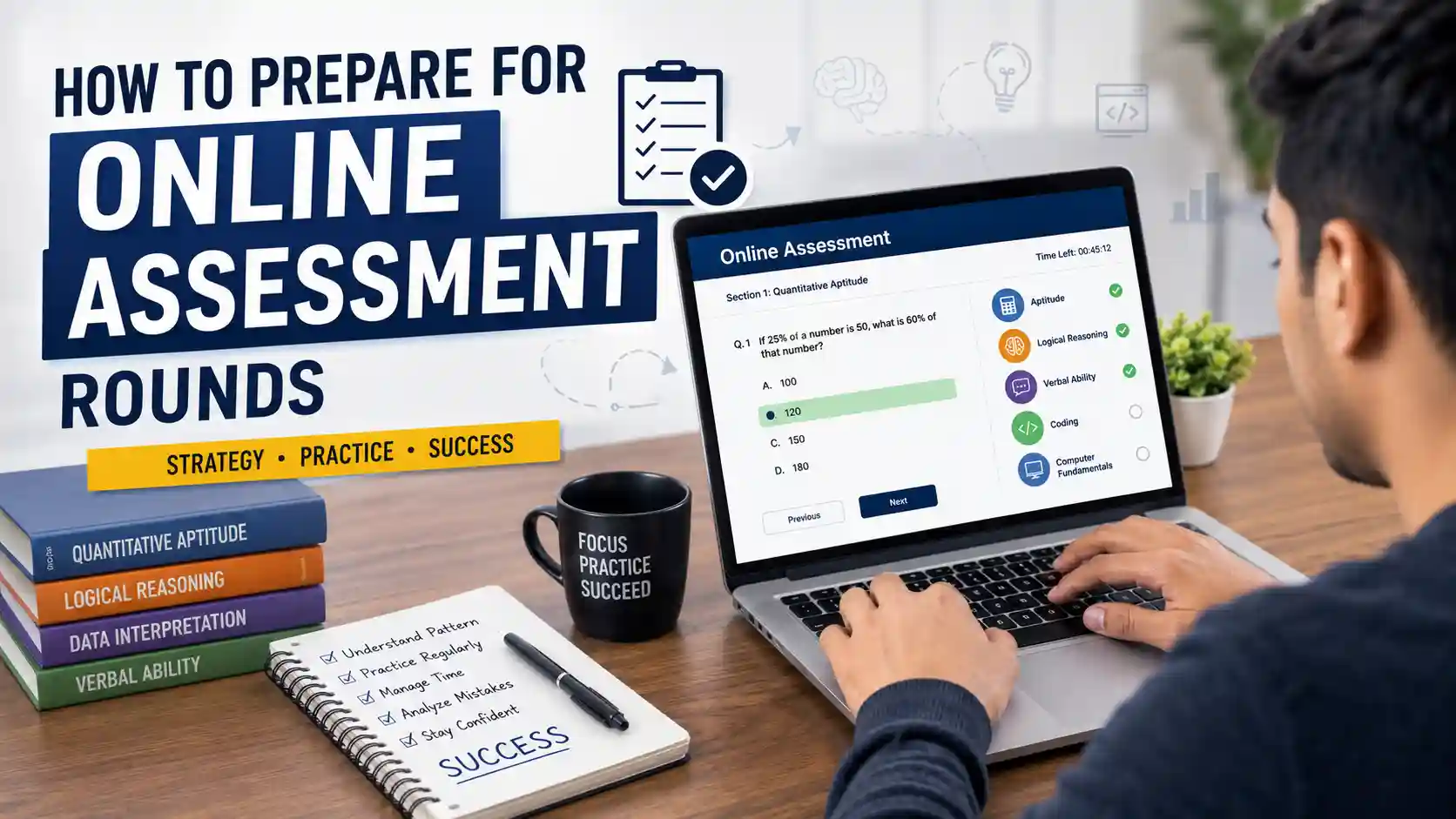
Online assessment rounds are now the first step in the hiring process of many companies. Whether you are applying for internships, fresher jobs, or off campus drives, you will most likely face an online assessment before interviews. Many students get rejected in this round because they do not understand the pattern properly or they prepare randomly without a strategy.
The good thing is that online assessments are not impossible to crack. With the right preparation and regular practice, anyone can improve their chances of clearing these rounds. You do not need to be a coding genius or a topper. What matters most is consistency, understanding the basics, and practicing smartly.
In this blog, we will understand how online assessments work, what sections are usually included, common mistakes students make, and how you can prepare effectively.
What is an Online Assessment Round?
An online assessment round is a test conducted by companies to filter candidates before interviews. These tests are usually conducted on platforms like HackerRank, Codility, Mettl, AMCAT, or company specific portals.
The assessment can include different sections such as:
- Aptitude questions
- Logical reasoning
- Verbal ability
- Coding problems
- Computer science MCQs
- Debugging questions
- Pseudo code questions
Some companies also include video based questions or communication tests.
The main purpose of this round is to check whether the candidate has the required problem solving skills and basic technical knowledge.
Understand the Pattern Before Preparation
One of the biggest mistakes students make is preparing without knowing the exam pattern.
Different companies have different assessment formats. For example:
- Service based companies focus more on aptitude and basic coding
- Product based companies focus heavily on DSA and problem solving
- Startup companies may ask practical coding questions and project related tasks
Before starting preparation, research the company properly. Check:
- Previous year questions
- Interview experiences
- Difficulty level
- Number of coding questions
- Time limit
- Important topics
This will help you prepare in the right direction.
Build Strong Aptitude Skills
Aptitude is one of the most important parts of online assessments, especially for freshers.
Common aptitude topics include:
- Percentage
- Profit and loss
- Ratio and proportion
- Time and work
- Time speed distance
- Probability
- Permutation and combination
- Number system
- Average
- Simplification
Many students ignore aptitude because they focus only on coding. But in reality, aptitude sections eliminate a large number of candidates.
Tips to Improve Aptitude
- Practice daily for at least 30 to 45 minutes
- Learn shortcut tricks for calculations
- Focus on accuracy first, then speed
- Solve mock tests regularly
- Analyze mistakes after every test
Websites like IndiaBix and PrepInsta are useful for aptitude practice.
Improve Logical Reasoning
Logical reasoning checks your thinking ability and problem solving approach.
Common topics include:
- Blood relations
- Seating arrangement
- Coding decoding
- Puzzle solving
- Direction sense
- Data interpretation
- Syllogism
These questions may look confusing at first, but regular practice makes them easier.
Best Strategy for Logical Reasoning
- Practice different question patterns
- Use diagrams whenever possible
- Improve time management
- Avoid spending too much time on a single puzzle
Consistency is very important here.
Prepare Coding Properly
Coding is the most important section for technical roles. Even companies that are not fully product based now include coding rounds.
Most online assessments include:
- 1 to 3 coding questions
- Easy to medium difficulty level
- Time based challenges
Important Topics for Coding Preparation
Focus on these topics:
- Arrays
- Strings
- Linked Lists
- Stack and Queue
- Sorting
- Searching
- Recursion
- Hashing
- Binary Search
- Sliding Window
- Two Pointer Technique
- Basic Dynamic Programming
If you are a beginner, start with easy problems first.
Practice on Coding Platforms
Regular coding practice is very important. Reading concepts alone will not help.
Some popular platforms are:
Start with easy questions and slowly move to medium level problems.
How Much Coding Practice is Enough?
You do not need to solve thousands of questions initially.
A better strategy is:
- Solve 2 to 3 questions daily
- Understand patterns properly
- Revise previously solved problems
- Learn from mistakes
Quality matters more than quantity.
Focus on Computer Science Fundamentals
Many companies include MCQs related to computer science subjects.
Important subjects include:
- DBMS
- Operating Systems
- Computer Networks
- OOPs
- SQL
- Basics of Software Engineering
Questions are usually theoretical and concept based.
Best Way to Prepare CS Fundamentals
- Make short notes
- Revise concepts regularly
- Practice MCQs
- Watch simple explanation videos
- Focus on important interview topics
You do not need to study everything deeply. Basic understanding is enough for most online tests.
Learn Time Management
Time management is one of the biggest challenges during online assessments.
Many students know the answers but fail because they spend too much time on difficult questions.
Smart Time Management Tips
- Attempt easy questions first
- Do not panic if one question is difficult
- Keep track of time regularly
- Avoid overthinking
- Practice timed mock tests
Mock tests help you understand your speed and improve confidence.
Solve Previous Year Questions
Previous year questions are extremely useful because companies often repeat patterns.
By solving previous papers, you can understand:
- Frequently asked topics
- Difficulty level
- Common question types
- Important concepts
Search for interview experiences and online assessment experiences on forums and student communities.
Take Mock Tests Seriously
Mock tests simulate the real exam environment.
Benefits of mock tests:
- Improve speed
- Build confidence
- Reduce exam fear
- Help identify weak areas
- Improve concentration
Try to take at least 2 to 3 mock tests every week during preparation.
After every mock test:
- Analyze mistakes carefully
- Note weak topics
- Revise concepts
- Practice similar questions again
Avoid Common Mistakes
Many students lose opportunities because of small mistakes.
Common Mistakes During Online Assessments
Ignoring Instructions
Always read instructions carefully before starting the test.
Spending Too Much Time on One Question
Move forward if you get stuck.
Lack of Practice
Theory alone is not enough.
Panic During the Test
Stay calm and focused.
Not Revising Basics
Strong fundamentals are very important.
Avoiding these mistakes can improve your performance significantly.
Prepare Your Setup Before the Test
Technical problems during assessments can create stress.
Before the exam:
- Check your internet connection
- Charge your laptop properly
- Keep a backup internet option ready
- Close unnecessary tabs and applications
- Use a quiet environment
Some assessments also use webcam monitoring, so stay prepared.
Communication and English Matter Too
Some companies include verbal ability sections.
Common topics include:
- Reading comprehension
- Grammar
- Sentence correction
- Vocabulary
How to Improve Verbal Ability
- Read English articles daily
- Practice grammar questions
- Learn common vocabulary
- Improve reading speed
Simple daily practice can improve your communication skills over time.
Stay Consistent Instead of Studying Randomly
Many students study heavily for two days and then stop for a week. This approach does not work well.
Instead:
- Study daily
- Follow a schedule
- Focus on small improvements
- Revise regularly
Even 2 to 3 focused hours daily can give excellent results if you stay consistent.
Best Daily Preparation Plan
Here is a simple preparation routine:
Morning
- Aptitude practice for 30 minutes
- Revise formulas and shortcuts
Afternoon
- Practice coding problems
- Learn one DSA concept
Evening
- Solve reasoning questions
- Revise CS fundamentals
Night
- Analyze mistakes
- Watch learning videos if needed
This type of balanced preparation helps improve all sections together.
Confidence is Very Important
Many students already assume they will fail before giving the assessment. This mindset creates pressure and reduces performance.
Remember:
- Every student starts somewhere
- Improvement takes time
- Practice builds confidence
- Small progress matters
Do not compare yourself with others continuously. Focus on improving your own skills.
Final Thoughts
Online assessment rounds may feel difficult in the beginning, but with proper preparation they become manageable. The key is understanding the exam pattern, practicing consistently, and improving step by step.
Focus on aptitude, coding, reasoning, and computer science fundamentals together. Solve mock tests regularly and learn from your mistakes. Avoid panic during exams and manage your time wisely.
Most importantly, stay patient with yourself. Success in placements does not happen overnight. Every question you solve and every mock test you attempt brings you closer to your goal.
If you stay disciplined and practice regularly, clearing online assessment rounds becomes much easier.