How Small Companies Give Faster Career Growth Than MNCs
6/8/2026, 10:18:29 AM
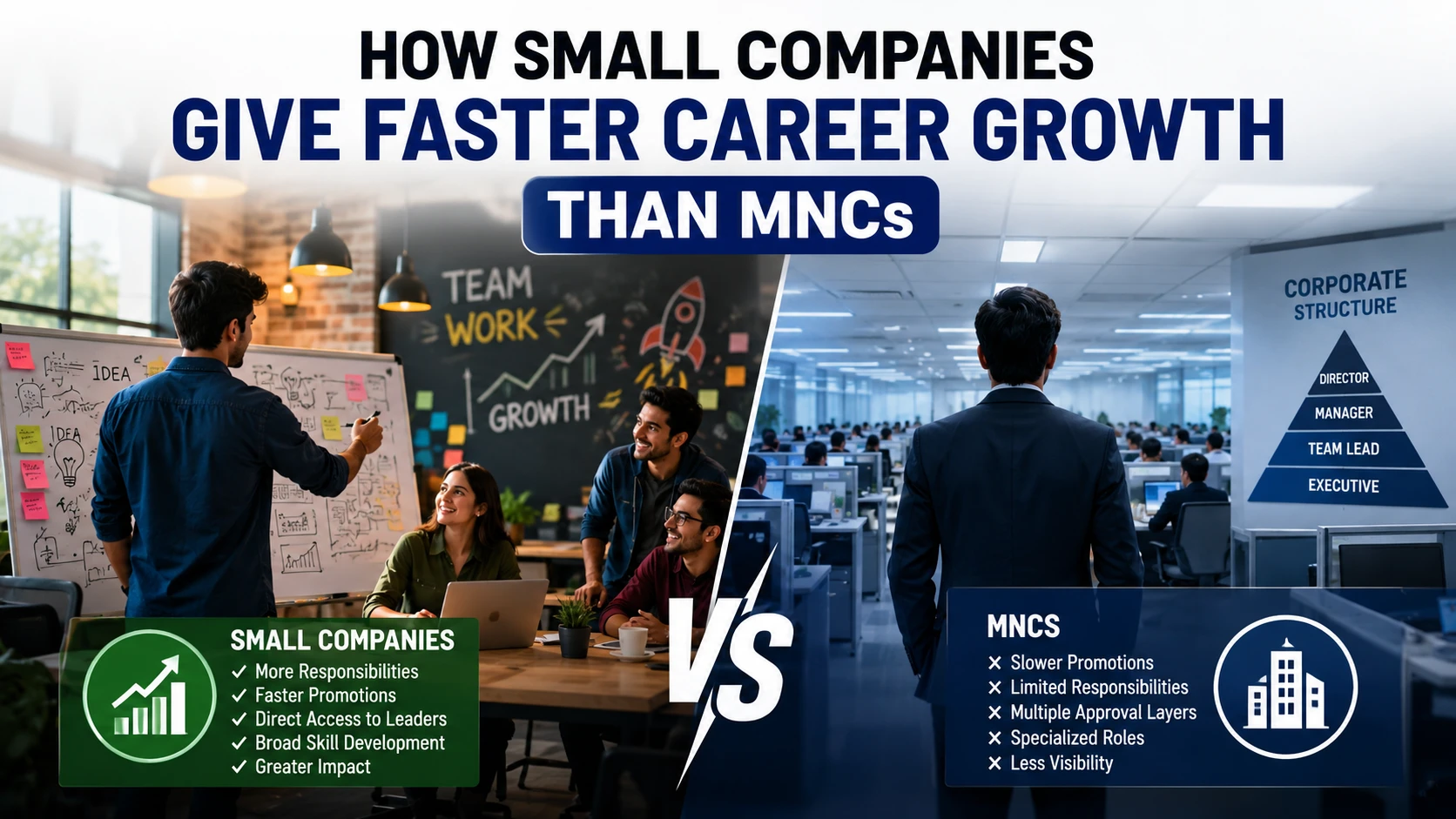
When students and fresh graduates start searching for jobs, most of them have one dream. They want to work in a famous multinational company. Names like Google, Microsoft, Amazon, Deloitte, Accenture, Infosys, and TCS often dominate career discussions. Many people believe that joining a large organization automatically guarantees a successful career.
While MNCs offer stability, global exposure, and strong brand value, they are not always the fastest path to professional growth.
In reality, many professionals experience significantly faster career progression in small companies, startups, and growing businesses. These organizations often provide opportunities that large corporations cannot offer because of their size, structure, and work culture.
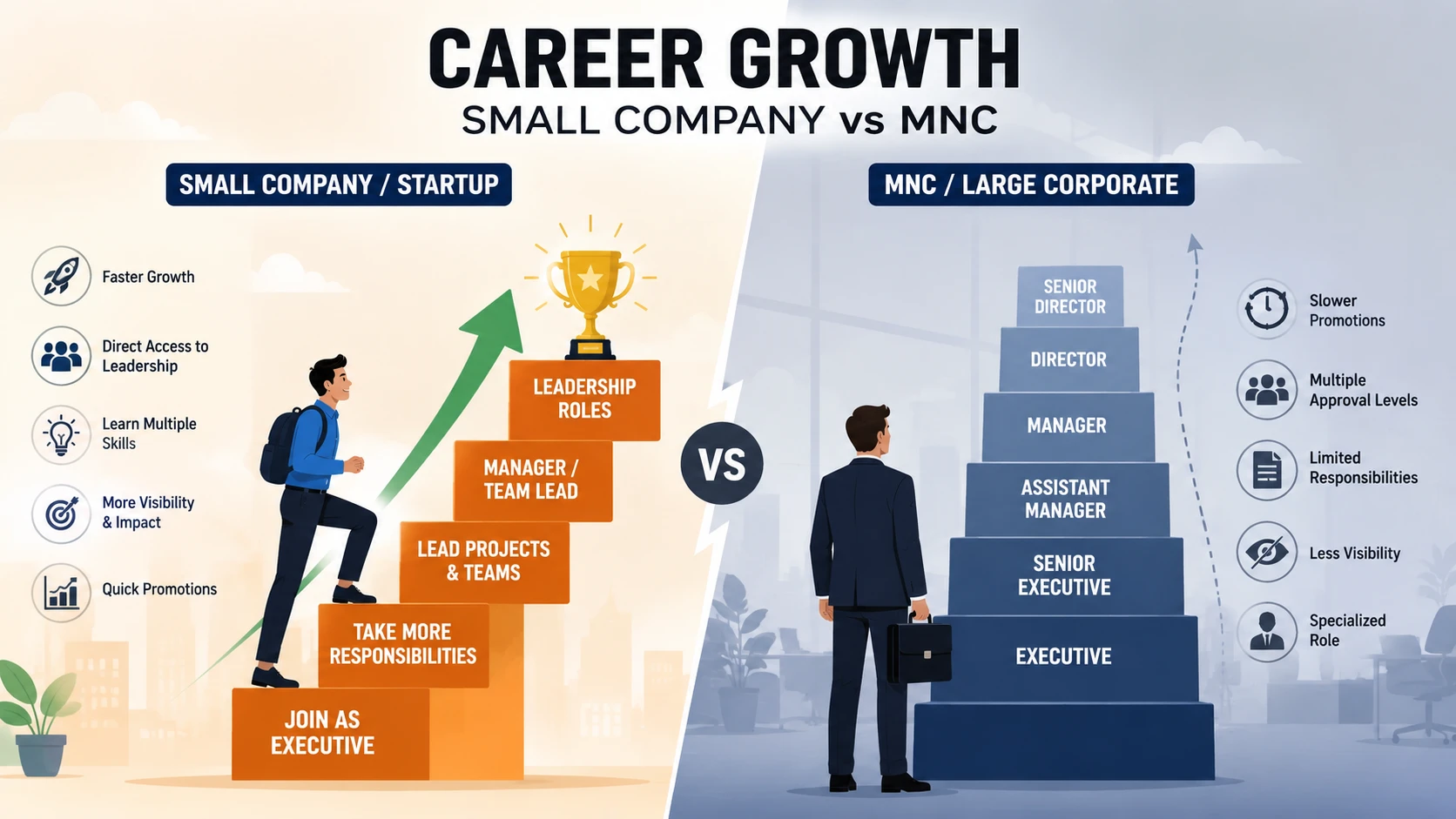
A person who joins a startup as a junior employee can sometimes become a team lead within a few years. The same growth journey might take much longer inside a large multinational corporation where promotions follow structured processes and multiple approval levels.
This does not mean that small companies are always better than MNCs. Both have advantages and disadvantages. However, for individuals focused on learning, responsibility, and rapid career advancement, small companies can provide unique opportunities that accelerate professional growth.
Let's explore why.
The Traditional Attraction of MNCs
Before understanding the advantages of small companies, it is important to understand why MNCs attract so many job seekers.
Large corporations usually provide:
- Established brand value
- Structured training programs
- Employee benefits
- Job stability
- International exposure
- Defined career paths
- Strong workplace policies
These benefits make MNCs attractive, especially for freshers who want a stable beginning.
However, there is one challenge.
Large organizations often have thousands of employees competing for the same opportunities. As a result, career progression can become slower than expected.
An employee may spend years working within a specific role before moving to the next level.
This is where small companies create a different experience.
Smaller Teams Mean Bigger Responsibilities
One of the biggest reasons people grow faster in small companies is responsibility.
In a large corporation, work is usually divided into specialized departments.
For example:
- One team handles frontend development.
- Another team manages backend systems.
- Another team handles testing.
- Another team manages deployment.
An employee often focuses on a very specific area.
In contrast, small companies operate with limited resources and smaller teams.
As a result, employees frequently work across multiple areas.
A software developer may:
- Write code
- Test applications
- Deploy software
- Communicate with clients
- Participate in product planning
This broader exposure helps professionals develop multiple skills simultaneously.
The more responsibilities you handle, the faster you learn.
Faster Learning Through Real-World Experience
Career growth depends heavily on learning speed.
In many MNCs, learning is structured through training programs and documented processes.
While this approach works well, it can sometimes slow down practical exposure.
Small companies often throw employees directly into real-world challenges.
You may find yourself:
- Solving client issues
- Managing projects
- Presenting ideas
- Handling deadlines
- Working directly with founders
These experiences force employees to learn quickly.
Instead of spending months observing processes, professionals actively participate in building solutions.
This practical learning often becomes a major career accelerator.
Direct Access to Leadership
In a multinational company, senior leadership can seem distant.
Employees may never directly interact with:
- Directors
- Vice Presidents
- Founders
- CEOs
Communication usually flows through multiple management layers.
Small companies are different.
Employees often work closely with founders and decision-makers.
This creates several advantages:
- Faster feedback
- Better mentorship
- Greater visibility
- Stronger networking opportunities
- Improved understanding of business operations
Learning directly from experienced leaders can significantly accelerate career development.
Many successful entrepreneurs started their careers in small organizations where they had direct access to company leadership.
Promotions Can Happen Much Faster
Promotion speed is one of the most noticeable differences.
In many MNCs, promotions depend on:
- Annual review cycles
- Organizational policies
- Budget approvals
- Headcount availability
- Performance ratings
Even high-performing employees sometimes wait years for role upgrades.
Small companies often operate differently.
When a business grows rapidly, new leadership positions emerge naturally.
A company that starts with:
- 10 employees
- Then grows to 50 employees
- Then grows to 100 employees
Needs managers, team leaders, and department heads.
Early employees often get these opportunities first.
This creates faster career progression compared to traditional corporate structures.
Employees Become More Visible
In large organizations, standing out can be difficult.
You may be one employee among thousands.
Even exceptional work can sometimes go unnoticed because managers oversee large teams.
Small companies provide greater visibility.
Leadership usually knows:
- Who performs well
- Who solves problems
- Who takes initiative
- Who contributes innovative ideas
Recognition often comes faster.
When decision-makers directly see your impact, career opportunities become easier to access.
More Opportunities to Build Leadership Skills
Leadership development is essential for long-term career success.
Many professionals want to become:
- Team leaders
- Managers
- Product owners
- Department heads
Small companies frequently provide these opportunities earlier.
Since teams are smaller, employees often:
- Lead projects
- Coordinate team members
- Communicate with clients
- Manage deadlines
- Make important decisions
These experiences build leadership capabilities that may take much longer to acquire in larger organizations.
Broader Skill Development
Large corporations usually encourage specialization.
This creates experts in specific domains.
For example:
- Database experts
- Cloud engineers
- Security specialists
- UI designers
While specialization is valuable, early-career professionals often benefit from broader exposure.
Small companies encourage versatility.
Employees frequently learn:
- Technical skills
- Communication skills
- Project management
- Problem-solving
- Business operations
This combination creates well-rounded professionals who can adapt to different career opportunities.
Faster Decision-Making Environment
Decision-making in MNCs often involves multiple layers.
A simple change may require approvals from:
- Managers
- Directors
- Compliance teams
- Business stakeholders
This process ensures quality but can slow execution.
Small companies usually have fewer approval layers.
Ideas can move from discussion to implementation quickly.
Employees learn:
- Agility
- Innovation
- Rapid execution
These qualities are highly valued in modern workplaces.
Greater Impact on Business Success
Many employees in large organizations contribute to small portions of huge projects.
While important, the overall business impact may feel distant.
In small companies, individual contributions are often highly visible.
A single employee may directly influence:
- Revenue growth
- Customer satisfaction
- Product development
- Process improvements
Seeing the direct impact of your work creates stronger motivation and professional confidence.
Entrepreneurial Mindset Development
One of the hidden benefits of small companies is entrepreneurial exposure.
Employees gain insights into:
- Sales
- Marketing
- Product development
- Operations
- Customer management
This understanding helps professionals think beyond their job descriptions.
Many founders and startup leaders developed their entrepreneurial skills by working in small businesses early in their careers.
Even if you never start your own company, this mindset makes you more valuable in the job market.
Salary Growth Can Accelerate Faster
People often assume that MNCs always pay more.
Initially, that may be true.
However, career growth influences long-term earnings.
In small companies:
- Promotions may happen faster
- Responsibilities increase quickly
- Leadership roles emerge earlier
As a result, compensation growth can accelerate significantly.
Many professionals who joined startups at junior levels later achieved management positions and higher salaries much faster than their peers in traditional corporate environments.
Better Understanding of the Entire Business
Most MNC employees understand their department very well.
However, they may have limited exposure to other business functions.
Small companies provide a broader perspective.
Employees learn how different departments connect:
- Product
- Sales
- Marketing
- Finance
- Customer Support
Understanding the bigger picture improves decision-making and career readiness.
Future managers and leaders benefit greatly from this exposure.
Faster Portfolio Building
A strong portfolio helps professionals secure better opportunities.
In small companies, employees often work on multiple projects.
This leads to:
- More achievements
- More case studies
- More responsibilities
- More measurable results
When applying for future roles, candidates can demonstrate real business impact rather than simply listing job responsibilities.
This makes resumes significantly stronger.
Adaptability Becomes a Competitive Advantage
Modern industries change rapidly.
Companies increasingly value adaptable professionals.
Small company environments naturally develop adaptability because employees frequently encounter:
- New challenges
- Changing priorities
- Resource limitations
- Market shifts
Professionals who adapt quickly often outperform others in long-term career growth.
Challenges of Small Companies
While small companies offer many advantages, they are not perfect.
Potential challenges include:
- Less job security
- Limited employee benefits
- Smaller training budgets
- Higher workloads
- Fewer structured processes
- Uncertain business growth
Not every startup succeeds.
Some companies may struggle financially or change direction frequently.
Therefore, candidates should evaluate opportunities carefully.
When MNCs Might Be the Better Choice
MNCs remain excellent choices for many professionals.
They may be better if you value:
- Stable career progression
- Global exposure
- International mobility
- Structured learning
- Large-scale project experience
- Strong employer branding
Many successful careers begin in MNCs and continue successfully for decades.
The best choice depends on personal goals.
Small Company vs MNC: Which One Is Right for You?
Choose a small company if you want:
- Rapid learning
- Faster responsibility growth
- Direct access to leadership
- Entrepreneurial exposure
- Broad skill development
- Faster promotions
Choose an MNC if you want:
- Stability
- Global opportunities
- Structured processes
- Formal training
- Strong brand recognition
- Predictable career paths
Neither option is universally better.
The right choice depends on what stage of your career you are currently in.
Final Thoughts
The belief that only multinational companies can build successful careers is becoming outdated. In today's fast-changing professional world, small companies and startups often provide opportunities for accelerated growth that larger organizations cannot easily match.
Smaller teams, broader responsibilities, direct leadership access, faster promotions, and hands-on learning create an environment where ambitious professionals can develop skills rapidly and build impressive careers.
Many of today's successful leaders, founders, and executives started in small organizations where they learned how businesses operate from the ground up.
If your primary goal is learning, responsibility, and career acceleration, a small company might be the fastest route to achieving professional success.
The company name on your resume matters, but the skills, experience, and impact you build matter even more. Sometimes the fastest path to a great career starts in a company that most people have never heard of.