Careers That Can Survive the AI Era
5/26/2026, 4:53:12 PM
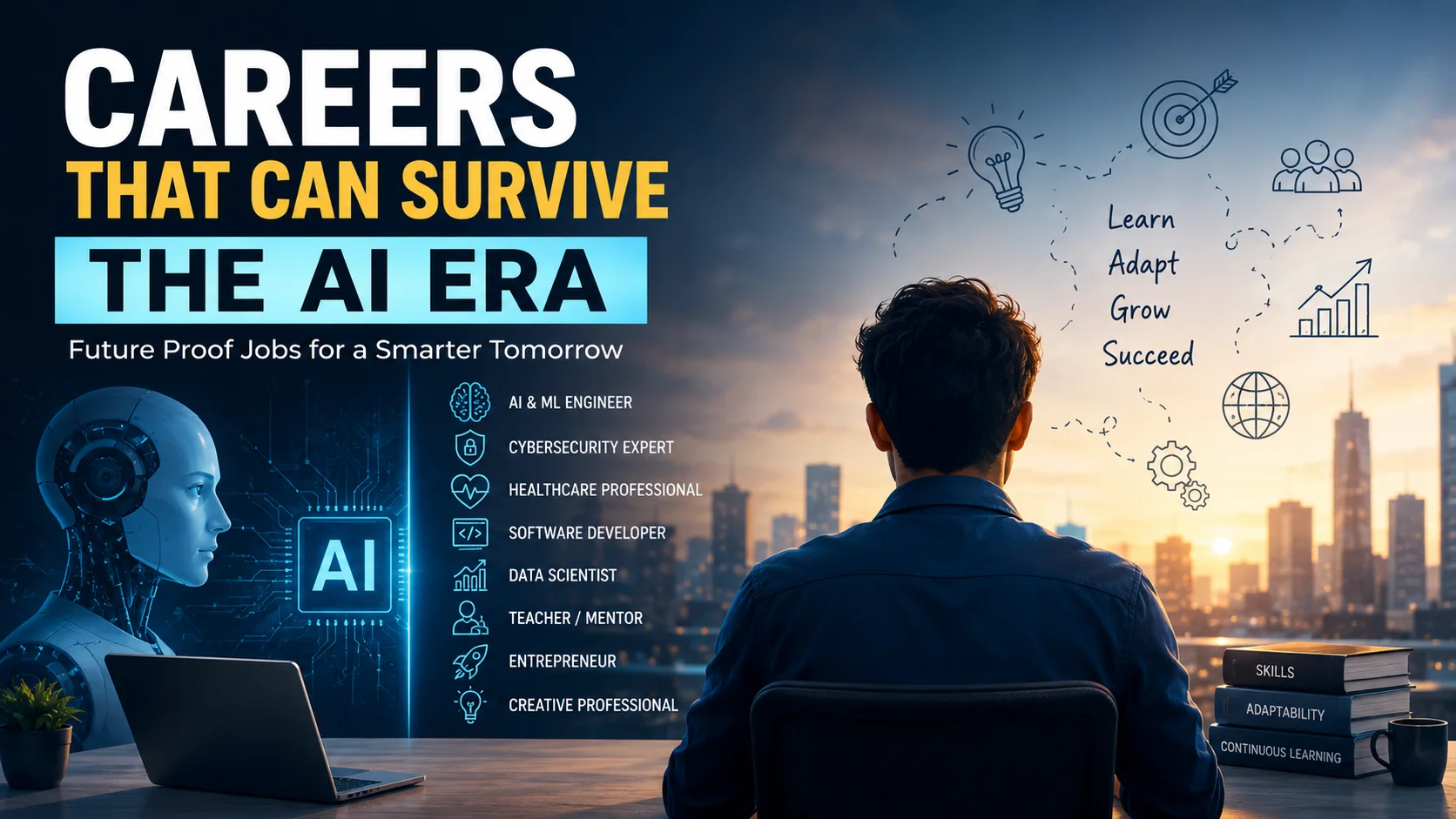
Artificial Intelligence is changing the world faster than most people expected. A few years ago, AI tools were only used by large tech companies. Today, students, freelancers, startups, and businesses use AI every single day. From writing content and generating images to coding and customer support, AI is becoming part of almost every industry.
Because of this, one question is becoming very common among students and professionals:
“Will AI replace my job?”
The truth is that some jobs will definitely change. Some repetitive roles may disappear completely. But at the same time, many careers will continue to grow because they require human thinking, creativity, emotions, leadership, problem solving, and real world decision making.
AI is powerful, but it still depends on humans.
The people who will succeed in the future are not the ones fighting against AI. They are the ones learning how to work with it.
In this blog, we will explore the careers that can survive the AI era, why these careers are safer, and how students can prepare for the future.
Why Some Careers Will Survive AI
AI works best when tasks are repetitive, predictable, and data-driven.
For example:
- Basic data entry
- Simple customer support
- Repetitive reporting
- Basic content rewriting
- Simple coding tasks
These types of jobs can be automated more easily.
But AI struggles when situations require:
- Human emotions
- Creativity
- Critical thinking
- Leadership
- Real world decision making
- Ethical judgment
- Communication
- Innovation
This is why careers involving people, strategy, and complex thinking are likely to survive and grow.
1. AI Engineers and Machine Learning Engineers
It may sound obvious, but the people building AI systems will remain highly valuable.
AI cannot improve itself completely without skilled professionals guiding the process. Companies need engineers who understand:
- Machine learning
- Deep learning
- Data pipelines
- Model optimization
- AI infrastructure
- Responsible AI systems
As AI adoption increases, demand for AI professionals is also increasing globally.
Students who learn:
- Python
- TensorFlow
- PyTorch
- Data Science
- Cloud computing
will have strong career opportunities in the coming years.
AI will not replace AI engineers anytime soon because humans still need to design, train, monitor, and improve these systems.
2. Cybersecurity Professionals
As technology grows, cyber threats are also growing rapidly.
AI can help detect attacks, but hackers are also using AI to create more advanced threats. Because of this, cybersecurity is becoming one of the most important industries in the world.
Companies need human experts who can:
- Investigate threats
- Respond to attacks
- Build secure systems
- Make security decisions
- Understand business risks
Cybersecurity roles that may remain strong:
- Security Analyst
- Ethical Hacker
- SOC Analyst
- Cloud Security Engineer
- Cybersecurity Consultant
This field combines technical knowledge with real-time human decision making, making it difficult for AI to fully replace.
3. Healthcare Professionals
Healthcare is not just about information. It is also about trust, empathy, and human connection.
Doctors, nurses, therapists, psychologists, and healthcare specialists deal with emotional and life-changing situations every day. AI can assist with diagnosis and reports, but patients still want real human interaction.
AI may help doctors become faster and more accurate, but it cannot fully replace:
- Human empathy
- Emotional support
- Ethical medical decisions
- Physical treatment procedures
Healthcare careers are expected to remain highly valuable for decades.
4. Skilled Software Developers
AI can generate code, but real software engineering is much more than writing code snippets.
Professional developers solve business problems, design systems, optimize performance, and manage complex applications.
Companies still need developers who can:
- Understand architecture
- Build scalable systems
- Solve production issues
- Handle security
- Work with teams
- Make technical decisions
Developers who only rely on copying code may struggle in the future. But developers who understand systems deeply will remain valuable.
Important future-proof development skills include:
- Cloud computing
- DevOps
- System design
- Backend architecture
- AI integration
- Security
- Database optimization
5. DevOps and Cloud Engineers
Modern applications depend heavily on cloud infrastructure.
Even AI systems need servers, deployment pipelines, monitoring systems, networking, and security infrastructure.
This is why DevOps and Cloud Engineering are becoming extremely important careers.
Professionals in this field manage:
- AWS
- Azure
- Google Cloud
- Docker
- Kubernetes
- CI/CD pipelines
- Linux servers
- Infrastructure automation
AI may automate some small tasks, but companies still need skilled engineers who can manage large-scale systems and solve infrastructure problems during critical situations.
This career is expected to remain strong because the internet itself runs on cloud infrastructure.
6. Product Managers and Business Strategists
AI can analyze data, but it cannot fully understand human markets, emotions, trends, and business direction like experienced professionals can.
Product managers make decisions about:
- User experience
- Market strategy
- Product growth
- Business priorities
- Team coordination
These roles require communication, leadership, and strategic thinking.
Companies need people who can connect technology with real business problems.
Professionals who understand both technology and business will have major advantages in the AI era.
7. Content Creators with Strong Personal Brands
AI can generate content quickly, but people still follow people.
Audiences trust creators who share:
- Real experiences
- Personal opinions
- Unique storytelling
- Human emotions
- Authentic journeys
This is why personal branding is becoming more important.
Creators who build trust on platforms like:
- YouTube
- X
- Blogs
can continue growing even in an AI-driven world.
The future belongs to creators who combine:
- Human creativity
- Consistency
- Community building
- AI tools for productivity
AI may help create content faster, but authentic human voices will still stand out.
8. Teachers, Mentors, and Trainers
Learning is emotional and interactive.
Students often need:
- Motivation
- Guidance
- Mentorship
- Personalized explanations
- Career advice
AI tools can assist in education, but they cannot fully replace experienced teachers and mentors who understand human behavior.
The education industry is evolving rapidly, especially in:
- Online learning
- Skill-based education
- Career mentoring
- Tech training
- Corporate training
Professionals who can teach effectively and simplify complex topics will continue to have strong opportunities.
9. Creative Professionals
Creativity remains one of the strongest human advantages.
AI can generate designs, images, videos, and music, but originality still matters.
Creative professionals who can think differently and create emotionally engaging experiences will remain valuable.
Fields likely to survive include:
- UI/UX Design
- Branding
- Film Production
- Creative Direction
- Marketing Strategy
- Animation
- Storytelling
The future may not eliminate creative jobs. Instead, it may increase demand for people who can creatively use AI tools better than others.
10. Entrepreneurship and Problem Solving Careers
One of the safest long-term career paths is entrepreneurship.
Businesses survive because they solve problems.
AI can help automate operations, but entrepreneurs still need to:
- Identify market opportunities
- Understand customers
- Build teams
- Create products
- Make strategic decisions
People who can build communities, solve real problems, and adapt quickly will always have opportunities.
The AI era may actually create more startup opportunities because technology is becoming easier to access.
The Biggest Skill That Will Survive AI
The most important future-proof skill is adaptability.
Technology changes constantly.
People who keep learning will survive.
People who stop learning may struggle.
Students should focus on:
- Communication skills
- Problem solving
- Technical knowledge
- Personal branding
- Networking
- Continuous learning
Instead of fearing AI, students should learn how to use it as a tool.
AI is not only replacing jobs. It is also creating new opportunities every year.
How Students Can Prepare for the AI Era
Here are practical steps students can take right now:
Learn Technical Skills
Even non-technical students should understand basic AI and digital tools.
Build Real Projects
Projects show practical skills better than certificates.
Improve Communication
Strong communication can separate average professionals from great professionals.
Create an Online Presence
A strong LinkedIn profile, portfolio, or blog can open career opportunities.
Learn AI Tools
Students who know how to use AI productively may become more efficient than others.
Stay Updated
Technology changes quickly. Staying informed is now a career skill.
Final Thoughts
The AI era is not the end of careers. It is the beginning of a new type of workforce.
Some jobs will disappear.
Some jobs will evolve.
Many new careers will appear.
The safest careers will belong to people who combine:
- Human intelligence
- Creativity
- Communication
- Technical skills
- Adaptability
AI is a tool, not a complete replacement for human potential.
Students who learn continuously, build strong skills, and adapt to technology will continue growing no matter how advanced AI becomes.
The future does not belong only to AI.
It belongs to people who know how to use AI wisely.