Career Paths That Are Growing Because of AI in 2026 and Beyond
6/7/2026, 8:54:18 AM
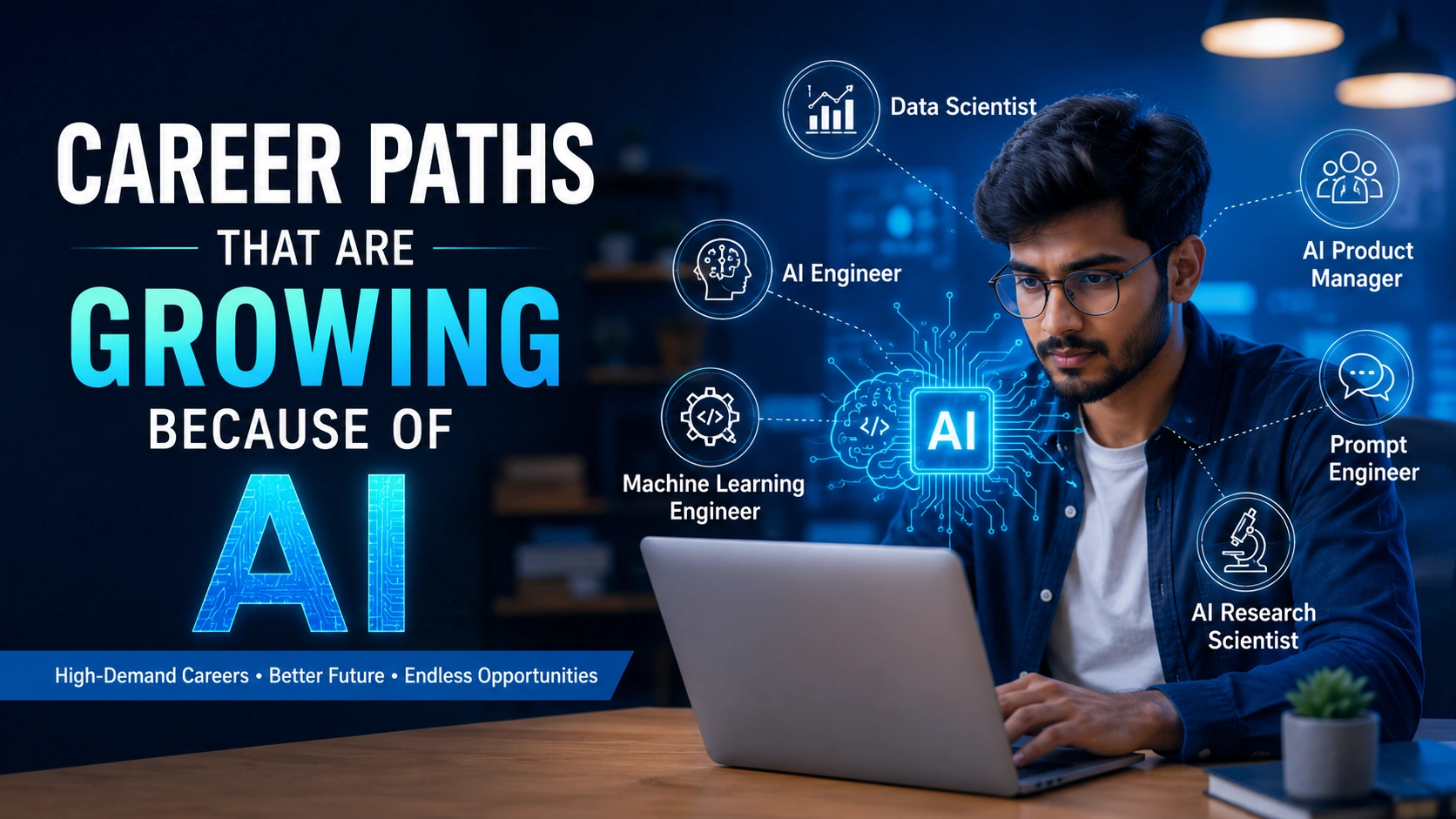
Artificial Intelligence (AI) is no longer a futuristic concept discussed only in research labs and technology conferences. It has become a core part of how businesses operate, how consumers interact with technology, and how industries innovate. From personalized recommendations on streaming platforms to advanced medical diagnostics and self-driving technologies, AI is reshaping the world at an unprecedented pace.
While many people worry that AI will replace jobs, the reality is more nuanced. AI is certainly automating repetitive tasks, but it is also creating entirely new career opportunities and increasing demand for professionals who can work alongside intelligent systems. Organizations across industries are investing heavily in AI-driven transformation, leading to the emergence of new roles and the evolution of existing professions.
For students, fresh graduates, and working professionals, understanding which career paths are growing because of AI can help them make informed decisions about education, skill development, and long-term career planning.
This guide explores some of the fastest-growing career paths influenced by AI and explains why they are expected to remain in high demand for years to come.
Why AI Is Creating More Jobs Than Many People Expect
Every major technological revolution has changed the nature of work. The internet created web developers, digital marketers, cybersecurity analysts, and couArtificial Intelligence (AI) is no longer a futuristic concept discussed only in research labs and technology conferences. It has become a core part of how businesses operate, how consumers interact with technology, and how industries innovate. From personalized recommendations on streaming platforms to advanced medical diagnostics and self-driving technologies, AI is reshaping the world at an unprecedented pace.
While many people worry that AI will replace jobs, the reality is more nuanced. AI is certainly automating repetitive tasks, but it is also creating entirely new career opportunities and increasing demand for professionals who can work alongside intelligent systems. Organizations across industries are investing heavily in AI-driven transformation, leading to the emergence of new roles and the evolution of existing professions.
For students, fresh graduates, and working professionals, understanding which career paths are growing because of AI can help them make informed decisions about education, skill development, and long-term career planning.
This guide explores some of the fastest-growing career paths influenced by AI and explains why they are expected to remain in high demand for years to come.
Why AI Is Creating More Jobs Than Many People Expect
Every major technological revolution has changed the nature of work. The internet created web developers, digital marketers, cybersecurity analysts, and countless other careers that barely existed decades ago. Similarly, AI is generating new opportunities that require human expertise, creativity, oversight, and strategic thinking.
Companies implementing AI solutions need professionals who can:
- Build AI systems
- Train machine learning models
- Manage data infrastructure
- Ensure ethical AI usage
- Integrate AI into business processes
- Monitor AI performance
- Create AI-powered products
- Protect AI systems from cyber threats
- Explain AI insights to decision-makers
As AI adoption grows, demand for skilled professionals continues to increase across both technical and non-technical fields.
1. AI Engineer
AI Engineers are among the most sought-after professionals in today's job market. They develop, deploy, and optimize artificial intelligence systems that power modern applications.
- Key Responsibilities
- Designing AI solutions
- Developing machine learning models
- Implementing deep learning algorithms
- Deploying AI applications
- Improving model performance
- Collaborating with software engineering teams
- Skills Required
- Python
- Machine Learning
- Deep LearningKey Responsibilities
- Designing AI solutions
- Developing machine learning models
- Implementing deep learning algorithms
- Deploying AI applications
- Improving model performance
- Collaborating with software engineering teams
- Skills Required
- Python
- Machine Learning
- Deep Learning
- TensorFlow
- PyTorch
- Data Structures
- Algorithms
- Cloud Platforms
- TensorFlow
- PyTorch
- Data Structures
- Algorithms
- Cloud Platforms
Why This Career Is Growing
Businesses want intelligent systems that can automate tasks, improve customer experiences, and generate insights from data. AI Engineers play a critical role in making this possible.
2. Machine Learning Engineer
Machine Learning Engineers focus specifically on creating systems that learn from data and improve over time.
- Responsibilities
- Building ML pipelines
- Training predictive models
- Data preprocessing
- Model deployment
- Performance monitoring
- Feature engineering
- Industries Hiring
- Healthcare
- Finance
- Retail
- Manufacturing
- E-commerce
- Technology
- Future Outlook
Machine learning powers recommendation systems, fraud detection, predictive maintenance, and many other applications. Demand continues to rise as organizations seek data-driven decision-making.
3. Data Scientist
Data Scientists transform raw data into actionable business insights.
What They Do
Analyze large datasets
Create predictive models
Identify business trends
Build dashboards
Present findings to stakeholders
Essential Skills
Statistics
SQL
Python
Data Visualization
Machine Learning
Business Analysis
Why AI Is Increasing Demand
AI systems rely heavily on quality data. Companies need Data Scientists to prepare, analyze, and interpret that data effectively.
4. AI Product Manager
AI Product Managers bridge the gap between technical teams and business goals.
Responsibilities
Defining product vision
Understanding customer needs
Managing AI development roadmaps
Coordinating engineering teams
Evaluating AI-driven features
Required Skills
Product Management
Business Strategy
AI Fundamentals
Communication
Market Research
Growth Potential
Many organizations are launching AI-powered products and services. Product Managers who understand AI have become extremely valuable.
5. Prompt Engineer
One of the newest careers emerging from generative AI is Prompt Engineering.
What Prompt Engineers Do
Design effective prompts
Optimize AI outputs
Test AI responses
Improve workflow automation
Build AI-assisted business processes
Skills Needed
Language Understanding
Critical Thinking
AI Tools Knowledge
Experimentation
Content Strategy
Why It Matters
Businesses increasingly rely on generative AI tools, making prompt optimization an important skill for improving productivity and output quality.
6. AI Research Scientist
AI Research Scientists work at the forefront of innovation.
Responsibilities
Developing new AI techniques
Conducting experiments
Publishing research papers
Improving machine learning algorithms
Exploring emerging technologies
Qualifications
Advanced Mathematics
Research Experience
Machine Learning
Deep Learning
PhD or Master's Degree (often preferred)
Career Outlook
As AI technology advances, organizations need researchers who can push the boundaries of what's possible.
7. Data Engineer
Data Engineers create the infrastructure that powers AI systems.
Key Tasks
Building data pipelines
Managing databases
Creating scalable architectures
Ensuring data quality
Supporting analytics systems
Popular Technologies
SQL
Apache Spark
Hadoop
AWS
Azure
Google Cloud
Why Demand Is Rising
AI is only as good as the data it receives. Organizations need reliable data infrastructure to support intelligent systems.
8. AI Ethics Specialist
As AI becomes more powerful, ethical concerns are becoming increasingly important.
Responsibilities
Evaluating AI fairness
Identifying bias
Developing ethical guidelines
Ensuring compliance
Monitoring AI decision-making
Skills Needed
Ethics
Policy Analysis
Data Governance
Risk Assessment
AI Knowledge
Future Importance
Governments and organizations are focusing more on responsible AI usage, making this a rapidly growing field.
9. Cybersecurity Analyst with AI Expertise
Cybersecurity is evolving alongside AI.
Responsibilities
Detecting cyber threats
Monitoring security systems
Using AI-powered security tools
Investigating incidents
Protecting sensitive data
Why AI Increases Demand
As attackers use AI to launch more sophisticated attacks, companies need security professionals who understand both cybersecurity and AI technologies.
10. AI Solutions Architect
AI Solutions Architects design enterprise-level AI systems.
Core Responsibilities
Designing AI infrastructure
Selecting technologies
Creating deployment strategies
Managing scalability
Guiding technical teams
Required Expertise
Cloud Computing
AI Frameworks
Software Architecture
Security
Business Strategy
Career Growth
Many large organizations need experts who can oversee complex AI implementations.
11. Robotics Engineer
AI is driving major advancements in robotics.
Work Includes
Designing robotic systems
Integrating AI algorithms
Testing autonomous systems
Improving robot performance
Industries
Manufacturing
Healthcare
Logistics
Agriculture
Defense
Future Potential
Automation continues to expand, creating strong demand for robotics professionals.
12. Business Intelligence Analyst
AI is transforming business intelligence.
Responsibilities
Analyzing business data
Creating reports
Identifying opportunities
Supporting strategic decisions
Valuable Skills
SQL
Power BI
Tableau
Data Analytics
Communication
Growth Drivers
Companies increasingly rely on AI-generated insights for decision-making.
13. Digital Marketing Specialist with AI Skills
Marketing is experiencing a major AI transformation.
AI-Powered Marketing Tasks
Content generation
Audience segmentation
Campaign optimization
Customer analysis
SEO improvements
Why Demand Is Growing
Businesses want marketers who can combine creativity with AI-powered efficiency.
14. Healthcare AI Specialist
Healthcare is rapidly adopting AI solutions.
Applications
Medical imaging
Disease prediction
Patient monitoring
Drug discovery
Clinical decision support
Required Knowledge
Healthcare Systems
Data Analysis
AI Technologies
Regulatory Compliance
Career Outlook
Healthcare AI is expected to become one of the fastest-growing sectors in the coming years.
15. AI Trainer and AI Operations Specialist
AI systems require continuous improvement and monitoring.
Responsibilities
Reviewing AI outputs
Labeling training data
Fine-tuning models
Quality assurance
Monitoring system performance
Why This Role Exists
Even advanced AI systems require human supervision to maintain accuracy and reliability.
Skills That Will Remain Valuable in the AI Era
Regardless of the career path you choose, certain skills will become increasingly important.
Technical Skills
Python Programming
Data Analysis
Machine Learning Basics
Cloud Computing
Cybersecurity
SQL
Automation Tools
Human Skills
Communication
Leadership
Creativity
Critical Thinking
Problem Solving
Emotional Intelligence
Adaptability
Professionals who combine technical expertise with strong human skills will have a significant advantage in the future job market.
How Students and Professionals Can Prepare
If you're planning your career in an AI-driven world, consider these steps:
Learn AI Fundamentals
Understanding the basics of AI and machine learning can help you stay competitive regardless of your field.
Build Practical Projects
Employers value real-world experience. Create projects that demonstrate your skills.
Earn Relevant Certifications
Popular certification areas include:
- Cloud Computing
- Data Analytics
- AI Fundamentals
- Cybersecurity
- Machine Learning
- Stay Updated
AI evolves rapidly. Follow industry news, research developments, and emerging technologies.
Focus on Lifelong Learning
Continuous learning will be essential as technology continues to evolve.
Final Thoughts
Artificial Intelligence is changing the employment landscape, but it is not simply eliminating jobs. Instead, it is transforming existing roles and creating entirely new career opportunities. From AI Engineers and Data Scientists to AI Ethics Specialists and AI Product Managers, organizations need professionals who can help them leverage AI effectively and responsibly.
The most successful professionals in the coming years will be those who embrace technology, continuously develop new skills, and learn how to collaborate with AI rather than compete against it. Whether you are a student choosing a career path, a fresher entering the workforce, or an experienced professional considering a career transition, now is an excellent time to explore AI-related opportunities.
The future of work will belong to people who understand both technology and human needs. By developing the right skills today, you can position yourself for long-term success in the AI-powered economy of tomorrow.ntless other careers that barely existed decades ago. Similarly, AI is generating new opportunities that require human expertise, creativity, oversight, and strategic thinking.
Companies implementing AI solutions need professionals who can:
- Build AI systems
- Train machine learning models
- Manage data infrastructure
- Ensure ethical AI usage
- Integrate AI into business processes
- Monitor AI performance
- Create AI-powered products
- Protect AI systems from cyber threats
- Explain AI insights to decision-makers
As AI adoption grows, demand for skilled professionals continues to increase across both technical and non-technical fields.
1. AI Engineer
AI Engineers are among the most sought-after professionals in today's job market. They develop, deploy, and optimize artificial intelligence systems that power modern applications.
Key Responsibilities
- Designing AI solutions
- Developing machine learning models
- Implementing deep learning algorithms
- Deploying AI applications
- Improving model performance
- Collaborating with software engineering teams
Skills Required
- Python
- Machine Learning
- Deep Learning
- TensorFlow
- PyTorch
- Data Structures
- Algorithms
- Cloud Platforms
Why This Career Is Growing
Businesses want intelligent systems that can automate tasks, improve customer experiences, and generate insights from data. AI Engineers play a critical role in making this possible.
2. Machine Learning Engineer
Machine Learning Engineers focus specifically on creating systems that learn from data and improve over time.
Responsibilities
- Building ML pipelines
- Training predictive models
- Data preprocessing
- Model deployment
- Performance monitoring
- Feature engineering
Industries Hiring
- Healthcare
- Finance
- Retail
- Manufacturing
- E-commerce
- Technology
Future Outlook
Machine learning powers recommendation systems, fraud detection, predictive maintenance, and many other applications. Demand continues to rise as organizations seek data-driven decision-making.
3. Data Scientist
Data Scientists transform raw data into actionable business insights.
What They Do
- Analyze large datasets
- Create predictive models
- Identify business trends
- Build dashboards
- Present findings to stakeholders
Essential Skills
- Statistics
- SQL
- Python
- Data Visualization
- Machine Learning
- Business Analysis
Why AI Is Increasing Demand
AI systems rely heavily on quality data. Companies need Data Scientists to prepare, analyze, and interpret that data effectively.
4. AI Product Manager
AI Product Managers bridge the gap between technical teams and business goals.
Responsibilities
- Defining product vision
- Understanding customer needs
- Managing AI development roadmaps
- Coordinating engineering teams
- Evaluating AI-driven features
Required Skills
- Product Management
- Business Strategy
- AI Fundamentals
- Communication
- Market Research
Growth Potential
Many organizations are launching AI-powered products and services. Product Managers who understand AI have become extremely valuable.
5. Prompt Engineer
One of the newest careers emerging from generative AI is Prompt Engineering.
What Prompt Engineers Do
- Design effective prompts
- Optimize AI outputs
- Test AI responses
- Improve workflow automation
- Build AI-assisted business processes
Skills Needed
- Language Understanding
- Critical Thinking
- AI Tools Knowledge
- Experimentation
- Content Strategy
Why It Matters
Businesses increasingly rely on generative AI tools, making prompt optimization an important skill for improving productivity and output quality.
6. AI Research Scientist
AI Research Scientists work at the forefront of innovation.
Responsibilities
- Developing new AI techniques
- Conducting experiments
- Publishing research papers
- Improving machine learning algorithms
- Exploring emerging technologies
Qualifications
- Advanced Mathematics
- Research Experience
- Machine Learning
- Deep Learning
- PhD or Master's Degree (often preferred)
Career Outlook
As AI technology advances, organizations need researchers who can push the boundaries of what's possible.
7. Data Engineer
Data Engineers create the infrastructure that powers AI systems.
Key Tasks
- Building data pipelines
- Managing databases
- Creating scalable architectures
- Ensuring data quality
- Supporting analytics systems
Popular Technologies
- SQL
- Apache Spark
- Hadoop
- AWS
- Azure
- Google Cloud
Why Demand Is Rising
AI is only as good as the data it receives. Organizations need reliable data infrastructure to support intelligent systems.
8. AI Ethics Specialist
As AI becomes more powerful, ethical concerns are becoming increasingly important.
Responsibilities
- Evaluating AI fairness
- Identifying bias
- Developing ethical guidelines
- Ensuring compliance
- Monitoring AI decision-making
Skills Needed
- Ethics
- Policy Analysis
- Data Governance
- Risk Assessment
- AI Knowledge
Future Importance
Governments and organizations are focusing more on responsible AI usage, making this a rapidly growing field.
9. Cybersecurity Analyst with AI Expertise
Cybersecurity is evolving alongside AI.
Responsibilities
- Detecting cyber threats
- Monitoring security systems
- Using AI-powered security tools
- Investigating incidents
- Protecting sensitive data
Why AI Increases Demand
As attackers use AI to launch more sophisticated attacks, companies need security professionals who understand both cybersecurity and AI technologies.
10. AI Solutions Architect
AI Solutions Architects design enterprise-level AI systems.
Core Responsibilities
- Designing AI infrastructure
- Selecting technologies
- Creating deployment strategies
- Managing scalability
- Guiding technical teams
Required Expertise
- Cloud Computing
- AI Frameworks
- Software Architecture
- Security
- Business Strategy
Career Growth
Many large organizations need experts who can oversee complex AI implementations.
11. Robotics Engineer
AI is driving major advancements in robotics.
Work Includes
- Designing robotic systems
- Integrating AI algorithms
- Testing autonomous systems
- Improving robot performance
Industries
- Manufacturing
- Healthcare
- Logistics
- Agriculture
- Defense
Future Potential
Automation continues to expand, creating strong demand for robotics professionals.
12. Business Intelligence Analyst
AI is transforming business intelligence.
Responsibilities
- Analyzing business data
- Creating reports
- Identifying opportunities
- Supporting strategic decisions
Valuable Skills
- SQL
- Power BI
- Tableau
- Data Analytics
- Communication
Growth Drivers
Companies increasingly rely on AI-generated insights for decision-making.
13. Digital Marketing Specialist with AI Skills
Marketing is experiencing a major AI transformation.
AI-Powered Marketing Tasks
- Content generation
- Audience segmentation
- Campaign optimization
- Customer analysis
- SEO improvements
Why Demand Is Growing
Businesses want marketers who can combine creativity with AI-powered efficiency.
14. Healthcare AI Specialist
Healthcare is rapidly adopting AI solutions.
Applications
- Medical imaging
- Disease prediction
- Patient monitoring
- Drug discovery
- Clinical decision support
Required Knowledge
- Healthcare Systems
- Data Analysis
- AI Technologies
- Regulatory Compliance
Career Outlook
Healthcare AI is expected to become one of the fastest-growing sectors in the coming years.
15. AI Trainer and AI Operations Specialist
AI systems require continuous improvement and monitoring.
Responsibilities
- Reviewing AI outputs
- Labeling training data
- Fine-tuning models
- Quality assurance
- Monitoring system performance
Why This Role Exists
Even advanced AI systems require human supervision to maintain accuracy and reliability.
Skills That Will Remain Valuable in the AI Era
Regardless of the career path you choose, certain skills will become increasingly important.
Technical Skills
- Python Programming
- Data Analysis
- Machine Learning Basics
- Cloud Computing
- Cybersecurity
- SQL
- Automation Tools
Human Skills
- Communication
- Leadership
- Creativity
- Critical Thinking
- Problem Solving
- Emotional Intelligence
- Adaptability
Professionals who combine technical expertise with strong human skills will have a significant advantage in the future job market.
How Students and Professionals Can Prepare
If you're planning your career in an AI-driven world, consider these steps:
Learn AI Fundamentals
Understanding the basics of AI and machine learning can help you stay competitive regardless of your field.
Build Practical Projects
Employers value real-world experience. Create projects that demonstrate your skills.
Earn Relevant Certifications
Popular certification areas include:
- Cloud Computing
- Data Analytics
- AI Fundamentals
- Cybersecurity
- Machine Learning
Stay Updated
AI evolves rapidly. Follow industry news, research developments, and emerging technologies.
Focus on Lifelong Learning
Continuous learning will be essential as technology continues to evolve.
Final Thoughts
Artificial Intelligence is changing the employment landscape, but it is not simply eliminating jobs. Instead, it is transforming existing roles and creating entirely new career opportunities. From AI Engineers and Data Scientists to AI Ethics Specialists and AI Product Managers, organizations need professionals who can help them leverage AI effectively and responsibly.
The most successful professionals in the coming years will be those who embrace technology, continuously develop new skills, and learn how to collaborate with AI rather than compete against it. Whether you are a student choosing a career path, a fresher entering the workforce, or an experienced professional considering a career transition, now is an excellent time to explore AI-related opportunities.
The future of work will belong to people who understand both technology and human needs. By developing the right skills today, you can position yourself for long-term success in the AI-powered economy of tomorrow.