AI Will Replace These Jobs First
5/15/2026, 7:08:49 AM
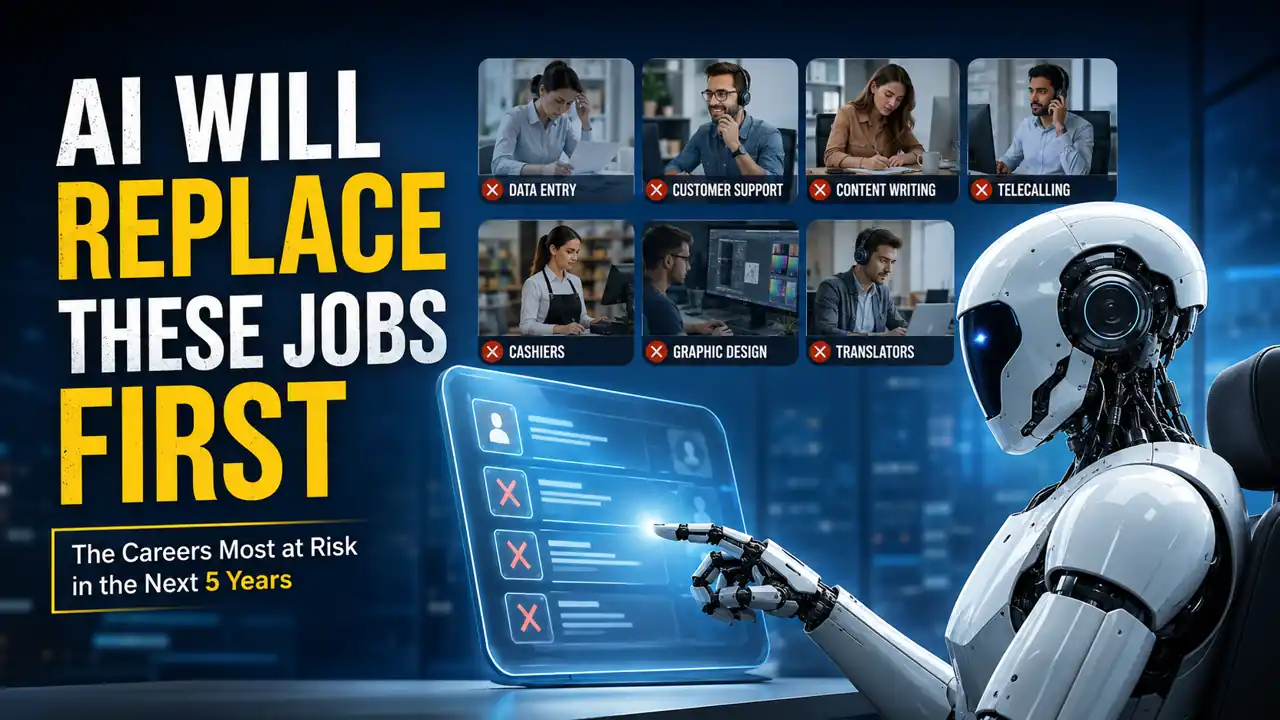
Artificial Intelligence is no longer just a futuristic concept. It is already changing how companies work, how people communicate, and how businesses hire employees. From chatbots handling customer support to AI tools writing content in seconds, automation is becoming part of everyday life.
Because of this, one question is becoming more common among students, freshers, and working professionals.
“Which jobs will AI replace first?”
The truth is that AI is not going to replace every job overnight. Many careers still require human creativity, emotional intelligence, decision making, and real world problem solving. But there are some jobs that are already being affected because repetitive work can now be done faster and cheaper using AI tools.
In this blog, we will look at the jobs most likely to be replaced first, why they are at risk, and what skills people should focus on to stay valuable in the future.
Why AI Is Replacing Some Jobs Faster
AI works best in jobs that involve:
- Repetitive tasks
- Predictable workflows
- Rule based decisions
- Large amounts of data processing
- Basic communication patterns
If a job mainly involves doing the same thing every day with little creativity or emotional interaction, AI can often automate a big part of that work.
Companies are adopting AI because it can:
- Reduce costs
- Work 24/7
- Increase productivity
- Handle large scale operations faster
- Reduce human errors
This does not always mean employees disappear completely. In many cases, fewer people are needed to do the same amount of work.
1. Data Entry Jobs
Data entry is one of the first jobs heavily affected by automation.
AI powered software can now:
- Read documents
- Extract information
- Fill spreadsheets automatically
- Process invoices
- Organize records
Earlier, companies needed large teams for manual data entry. Today, OCR technology and AI systems can do the same work in minutes.
This does not mean every data entry role will vanish immediately, but the demand is already decreasing.
Why It Is At Risk
- Highly repetitive work
- Minimal creativity required
- Easy to automate using software
2. Customer Support Executives
Many companies now use AI chatbots for customer support.
When you visit a website and receive instant replies from a support assistant, there is a high chance AI is handling the conversation.
Modern AI chatbots can:
- Answer FAQs
- Track orders
- Solve basic problems
- Handle refund requests
- Guide customers step by step
Large companies are saving millions by automating first level support.
What Will Still Need Humans
Human agents will still be important for:
- Complex customer issues
- Emotional situations
- Sales conversations
- High value clients
But entry level support jobs may reduce significantly over the next few years.
3. Basic Content Writing Jobs
AI writing tools are improving rapidly.
Simple blog posts, product descriptions, captions, and basic marketing content can now be generated in seconds.
Many businesses that previously hired beginner writers for simple content are now using AI tools instead.
Content Writing Roles Most At Risk
- Product description writers
- Basic SEO article writers
- Repetitive content creators
- Simple social media caption writers
Content Roles That Will Survive
Writers who focus on:
- Deep research
- Personal storytelling
- Branding
- Original opinions
- Strategy
- Technical expertise
will still remain valuable.
Human creativity and real experiences still matter.
4. Telecalling and Cold Calling Jobs
AI voice systems are becoming surprisingly realistic.
Some businesses already use AI callers for:
- Appointment scheduling
- Survey collection
- Basic sales calls
- Follow ups
AI can handle thousands of calls without breaks.
Because of this, repetitive telecalling jobs are becoming vulnerable.
Why AI Works Well Here
- Scripts are predictable
- Conversations follow patterns
- Responses are limited
However, high level sales roles that require negotiation and relationship building are still safer.
5. Cashiers and Billing Staff
Self checkout systems and automated billing are already common in many countries.
AI powered systems can:
- Scan products
- Process payments
- Detect fraud
- Manage inventory
Retail stores are slowly reducing dependency on manual billing staff.
Industries Most Affected
- Supermarkets
- Fast food chains
- Retail stores
- Ticket counters
This transition may take longer in some countries, but automation is clearly increasing.
6. Basic Graphic Design Jobs
AI image generation tools are changing the design industry quickly.
Businesses can now generate:
- Social media posts
- Posters
- Logos
- Thumbnails
- Ad creatives
using AI within minutes.
Design Work Most At Risk
- Template based designs
- Basic banner creation
- Repetitive social media graphics
Designers Who Will Still Be Valuable
Creative professionals who understand:
- Branding
- User psychology
- Marketing strategy
- Advanced visual storytelling
will continue to stay in demand.
7. Translators for Simple Languages
AI translation tools have improved massively.
Basic translations between common languages are now handled quite well by AI systems.
This affects:
- Simple document translation
- Basic subtitles
- Standard communication content
But human translators are still needed for:
- Legal documents
- Cultural accuracy
- Literature
- Sensitive communication
8. Manufacturing Line Workers
Factories are increasingly using robots and AI automation.
Machines can now:
- Assemble products
- Sort items
- Pack products
- Inspect quality
Automation improves efficiency and reduces errors.
Large manufacturing companies are investing heavily in smart factories.
Why This Trend Will Grow
- Machines work continuously
- Lower long term costs
- Faster production
Still, skilled technicians and engineers who manage automation systems will remain important.
9. Basic Accounting Jobs
AI accounting software can now:
- Track expenses
- Generate invoices
- Calculate taxes
- Create financial reports
Small businesses are using automated accounting tools instead of hiring large accounting teams.
Roles Most At Risk
- Junior bookkeeping
- Invoice processing
- Basic financial data handling
Safer Finance Careers
Professionals involved in:
- Financial strategy
- Auditing
- Business consulting
- Investment planning
will remain more secure.
10. Travel Agents for Standard Bookings
AI platforms can now help users:
- Book flights
- Compare hotels
- Create travel plans
- Recommend destinations
This has reduced the demand for traditional travel booking agents.
However, luxury travel planning and personalized travel consulting still require human expertise.
Jobs AI Cannot Easily Replace
While many jobs are at risk, some careers are much safer because they require human thinking, creativity, emotional intelligence, or physical presence.
Examples include:
- Doctors
- Therapists
- Teachers
- Entrepreneurs
- Software architects
- Skilled engineers
- Researchers
- Lawyers
- Creative directors
- Electricians
- Plumbers
AI can assist these professionals, but replacing them fully is extremely difficult.
The Biggest Mistake Students Are Making
Many students are still preparing only for traditional repetitive jobs.
That is risky now.
The future belongs to people who can:
- Solve problems
- Communicate clearly
- Learn fast
- Think creatively
- Use AI effectively
- Build real world skills
Instead of fearing AI, students should learn how to work with it.
People who understand AI tools will often replace people who do not.
Skills That Will Stay Valuable
If you want a safer career in the AI era, focus on skills like:
Communication Skills
Good communication is still difficult for AI to replace completely.
Creativity
Original thinking and innovation remain highly valuable.
Technical Skills
Fields like:
- AI engineering
- Cybersecurity
- Cloud computing
- DevOps
- Data science
are growing rapidly.
Leadership
Companies still need humans to manage teams and make strategic decisions.
Problem Solving
AI gives answers, but humans still define the right problems to solve.
Should You Be Worried About AI?
You should not panic, but you should adapt.
Every major technology shift changes the job market. The internet changed industries. Smartphones changed industries. AI will do the same.
Some jobs will disappear.
Some jobs will evolve.
Many new jobs will also be created.
The people who succeed will not necessarily be the smartest people. They will be the people who adapt quickly.
Final Thoughts
AI is already transforming the global workforce. Jobs that involve repetitive and predictable tasks are the first to be affected. Data entry, telecalling, basic customer support, and simple content creation roles are becoming increasingly automated.
But this does not mean the future is hopeless.
In fact, this is one of the best times to build valuable skills.
People who learn creativity, communication, technology, and problem solving will continue to find opportunities even in an AI driven world.
Instead of asking, “Will AI replace me?”
A better question is:
“How can I become someone AI cannot easily replace?”