AI Is Replacing These Entry-Level Jobs Faster Than Expected (2026)
6/23/2026, 12:42:47 PM
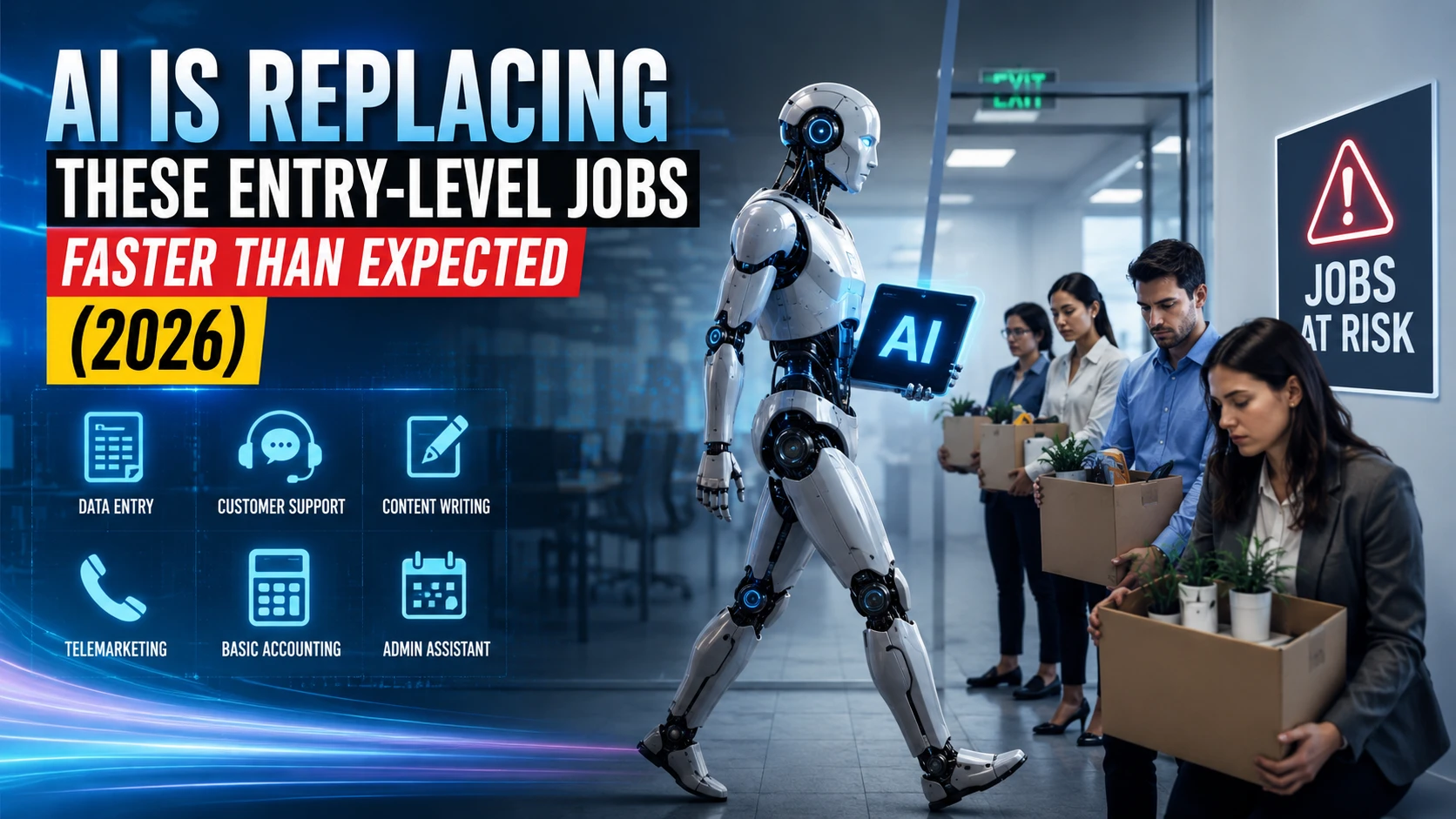
Artificial Intelligence is no longer a futuristic concept. It is already transforming industries, changing how businesses operate, and reshaping the job market at a speed many professionals did not expect. While AI creates new opportunities, it is also reducing the demand for certain entry-level roles that were traditionally considered stepping stones for fresh graduates and beginners.
In 2026, companies across technology, finance, marketing, customer support, media, and administrative sectors are increasingly using AI tools to automate repetitive tasks. This shift is helping businesses reduce costs, improve efficiency, and scale operations faster than ever before.
For students, freshers, and job seekers, understanding which jobs are most vulnerable to AI is becoming essential. The goal is not to fear AI but to adapt and build skills that complement it.
In this article, we will explore the entry-level jobs being affected the most, why companies are adopting AI solutions, and how you can future-proof your career.
Why Companies Are Replacing Entry-Level Roles with AI
Most entry-level jobs involve repetitive and predictable tasks. AI systems excel at handling these activities because they can process large amounts of information quickly and consistently.
Businesses are investing heavily in AI because it offers several advantages:
- Lower operational costs
- Faster task completion
- Reduced human errors
- 24/7 availability
- Improved productivity
- Better scalability
Instead of hiring multiple employees to perform routine tasks, organizations can deploy AI tools that complete the same work in seconds.
This does not mean humans are becoming obsolete. It means that routine work is becoming automated while demand grows for creative, strategic, analytical, and interpersonal skills.
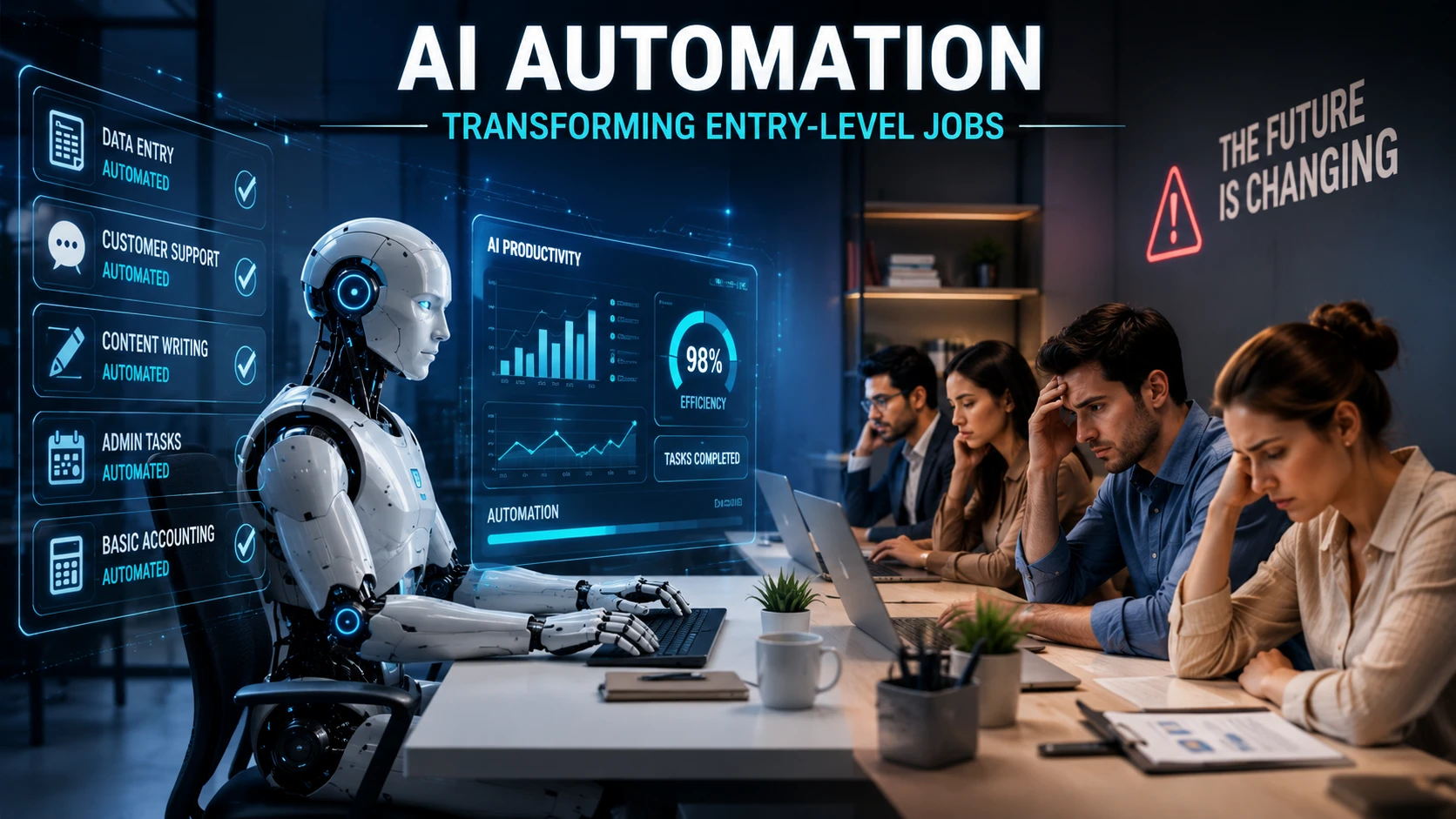
1. Data Entry Operators
Data entry has been one of the most affected job categories.
Traditionally, data entry operators manually entered information from documents, spreadsheets, forms, and databases. Modern AI systems can now extract, organize, verify, and update data automatically.
Advanced Optical Character Recognition (OCR) technology combined with AI can read invoices, contracts, receipts, and forms with impressive accuracy.
Why AI Is Replacing This Role
- Automated document processing
- Intelligent form recognition
- Faster data validation
- Reduced manual workload
Future Outlook
The demand for pure data entry roles is expected to continue declining. Professionals who combine data management skills with analytics, reporting, or business intelligence will have better opportunities.
2. Customer Support Representatives
Customer support has changed dramatically in recent years.
Many companies now deploy AI-powered chatbots and virtual assistants capable of answering common customer queries instantly.
Customers can receive support for:
- Account issues
- Password resets
- Product information
- Order tracking
- Basic troubleshooting
Without needing human intervention.
Why AI Is Replacing This Role
- Instant response times
- Lower support costs
- Multilingual communication
- Round-the-clock availability
Future Outlook
Human agents are still needed for complex issues, emotional conversations, and relationship management. Future customer support professionals will focus more on problem-solving than answering repetitive questions.
3. Content Writers Focused on Basic Articles
AI writing tools have become surprisingly capable.
Businesses can now generate product descriptions, basic blog drafts, social media captions, and marketing copy in minutes.
Entry-level content writers who only create generic articles face increasing competition from AI systems.
Why AI Is Replacing This Role
- Faster content production
- Lower content creation costs
- Instant idea generation
- High scalability
Future Outlook
Writers who specialize in storytelling, research, thought leadership, industry expertise, and brand voice development remain valuable. Creativity and originality are becoming more important than ever.
4. Junior Graphic Designers for Basic Tasks
AI image generation tools are changing the design industry.
Simple tasks such as:
- Social media banners
- Marketing graphics
- Product mockups
- Basic advertisements
can now be generated quickly using AI platforms.
Why AI Is Replacing This Role
- Faster design creation
- Reduced turnaround times
- Lower costs for businesses
- Easy content customization
Future Outlook
Creative designers who understand branding, user experience, visual strategy, and advanced design principles will continue to be in demand.
5. Administrative Assistants
Administrative roles often involve scheduling, document management, meeting coordination, and email handling.
AI assistants can now automate many of these responsibilities.
Modern AI tools can:
- Schedule meetings
- Manage calendars
- Draft emails
- Create summaries
- Organize documents
Why AI Is Replacing This Role
- Improved efficiency
- Better time management
- Reduced administrative overhead
Future Outlook
Administrative professionals who develop project management, operations, and communication skills will remain valuable assets to organizations.
6. Telemarketing Executives
Cold calling and repetitive sales outreach are increasingly being automated.
AI voice systems can now handle:
- Initial lead qualification
- Appointment scheduling
- Customer surveys
- Follow-up reminders
at scale.
Why AI Is Replacing This Role
- Consistent communication
- Lower labor costs
- High-volume outreach capabilities
Future Outlook
Sales professionals who focus on relationship building, negotiations, enterprise sales, and strategic consulting will continue to thrive.
7. Junior Research Analysts
Many entry-level research tasks involve collecting information, summarizing reports, and identifying trends.
AI tools can now analyze thousands of documents within minutes and generate detailed summaries.
Why AI Is Replacing This Role
- Faster information gathering
- Automated report generation
- Improved data analysis
Future Outlook
Analysts who can interpret data, make business recommendations, and communicate insights effectively will remain highly valuable.
8. Basic Accounting and Bookkeeping Roles
Accounting software powered by AI is reducing the need for manual bookkeeping.
Tasks such as:
- Invoice processing
- Expense categorization
- Transaction matching
- Financial record maintenance
can now be automated.
Why AI Is Replacing This Role
- Greater accuracy
- Faster processing
- Reduced compliance risks
Future Outlook
Finance professionals who specialize in auditing, taxation, financial planning, and business strategy will continue to see strong demand.
9. Junior Recruiters
Recruitment teams increasingly use AI to screen resumes, identify suitable candidates, and schedule interviews.
AI can evaluate thousands of applications much faster than human recruiters.
Why AI Is Replacing This Role
- Automated resume screening
- Candidate matching
- Faster hiring workflows
Future Outlook
Recruiters who excel at candidate engagement, employer branding, talent strategy, and relationship building will remain important.
10. Basic Software Testing Roles
Software testing has also been affected by automation.
AI-powered testing platforms can automatically identify bugs, execute test cases, and generate reports.
Why AI Is Replacing This Role
- Faster testing cycles
- Reduced manual effort
- Continuous testing capabilities
Future Outlook
Quality assurance professionals who understand automation frameworks, security testing, and performance optimization will remain valuable.
Jobs That Are Safer from AI in 2026
While many routine jobs are being automated, several careers remain relatively resistant to AI because they require human judgment, creativity, emotional intelligence, or complex decision-making.
Some examples include:
- Product Managers
- UX Designers
- AI Engineers
- Cybersecurity Specialists
- Data Scientists
- Business Consultants
- Healthcare Professionals
- Sales Consultants
- Project Managers
- Digital Marketing Strategists
These roles involve skills that AI currently struggles to replicate effectively.
Skills That Will Help You Stay Relevant
Instead of competing against AI, professionals should learn how to work alongside it.
The most valuable skills in 2026 include:
AI Literacy
Understanding how AI tools work is becoming a basic career requirement.
Critical Thinking
Employers increasingly value professionals who can analyze situations and make informed decisions.
Communication Skills
Strong communication remains one of the most difficult human abilities for AI to replace.
Problem Solving
Organizations need employees who can tackle unique challenges rather than follow predefined instructions.
Creativity
Creative thinking remains one of the strongest competitive advantages humans possess.
Technical Skills
Learning areas such as:
- Data Analysis
- Cloud Computing
- Cybersecurity
- Software Development
- AI Engineering
can significantly improve career prospects.
How Freshers Can Prepare for the AI Era
If you are a student or recent graduate, the best approach is not to avoid AI but to embrace it.
Here are practical steps:
- Learn AI tools related to your industry.
- Build real-world projects.
- Develop communication and presentation skills.
- Create a strong LinkedIn profile.
- Learn problem-solving techniques.
- Stay updated with industry trends.
- Focus on continuous learning.
- Build a personal portfolio.
- Gain practical experience through internships.
- Learn how to use AI as a productivity tool.
Professionals who understand AI will often outperform those who ignore it.
The Reality: AI Is Changing Jobs, Not Eliminating Human Potential
Throughout history, technological advancements have changed the nature of work.
The internet transformed industries.
Cloud computing changed software development.
Smartphones reshaped communication.
Now, AI is creating another major shift.
Some jobs will disappear. Many jobs will evolve. Entirely new careers will emerge.
The biggest risk is not AI itself. The biggest risk is refusing to adapt.
Individuals who continuously learn, upgrade their skills, and leverage AI effectively will find new opportunities in the changing job market.
Conclusion
AI is replacing several entry-level jobs faster than many experts predicted. Roles involving repetitive, rule-based, and predictable tasks are particularly vulnerable to automation in 2026.
However, this transformation is not necessarily bad news. While some positions are shrinking, demand is growing for professionals who bring creativity, critical thinking, emotional intelligence, and strategic decision-making to the workplace.
The future belongs to people who learn how to collaborate with AI rather than compete against it. Whether you are a student, fresher, or working professional, now is the perfect time to invest in skills that will remain valuable in an AI-driven world.
The job market is changing rapidly, but opportunities are still abundant for those willing to evolve with technology.
Frequently Asked Questions (FAQs)
1. Which entry-level jobs are most at risk from AI in 2026?
Jobs involving repetitive and predictable tasks are the most vulnerable. These include data entry operators, customer support agents handling basic queries, telemarketers, junior recruiters, basic bookkeeping professionals, and administrative assistants.
2. Will AI completely replace human workers?
No. AI is more likely to automate specific tasks rather than entire professions. Human skills such as creativity, critical thinking, leadership, emotional intelligence, and complex problem-solving remain highly valuable.
3. Is content writing still a good career in the AI era?
Yes. While AI can generate basic content, businesses still need skilled writers who can create original insights, conduct research, build brand authority, and connect with readers through storytelling.
4. Which careers are expected to grow because of AI?
Careers such as AI Engineer, Data Scientist, Machine Learning Engineer, Cybersecurity Analyst, Cloud Engineer, AI Product Manager, and Digital Marketing Strategist are expected to see strong demand in the coming years.
5. Can freshers still find jobs despite AI automation?
Absolutely. Freshers who develop in-demand skills, build projects, learn AI tools, and stay updated with industry trends can still find excellent career opportunities across multiple industries.
6. What skills should students learn to stay relevant?
Students should focus on AI literacy, communication skills, critical thinking, problem-solving, data analysis, programming, cloud computing, cybersecurity, and project management.
7. Is software development safe from AI?
Software development is evolving rather than disappearing. AI can assist with coding, debugging, and testing, but developers are still needed to design systems, solve business problems, and make technical decisions.
8. How can professionals use AI to their advantage?
Professionals can use AI to automate repetitive tasks, improve productivity, generate ideas, analyze data, create reports, and focus more on high-value strategic work.
9. Should I avoid careers that are being affected by AI?
Not necessarily. Many affected careers are evolving rather than disappearing. The key is to continuously upgrade your skills and learn how to work alongside AI tools.
10. What is the best way to future-proof a career in 2026?
The best strategy is to combine technical knowledge with human skills. Learning AI tools, building practical experience, improving communication abilities, and continuously adapting to industry changes can help ensure long-term career growth.